
By Christopher Piercecchi, MD — Physician and Wellness Manager, Founder, The Men’s Clinic for Wellness & Vitality
SITREP is an evidence-review briefing for patients and colleagues of The Men’s Clinic for Wellness & Vitality. It is educational and does not constitute individualized medical advice.
One of the things I’ve wanted to write about for a long time is the idea of self-perceived health in men.
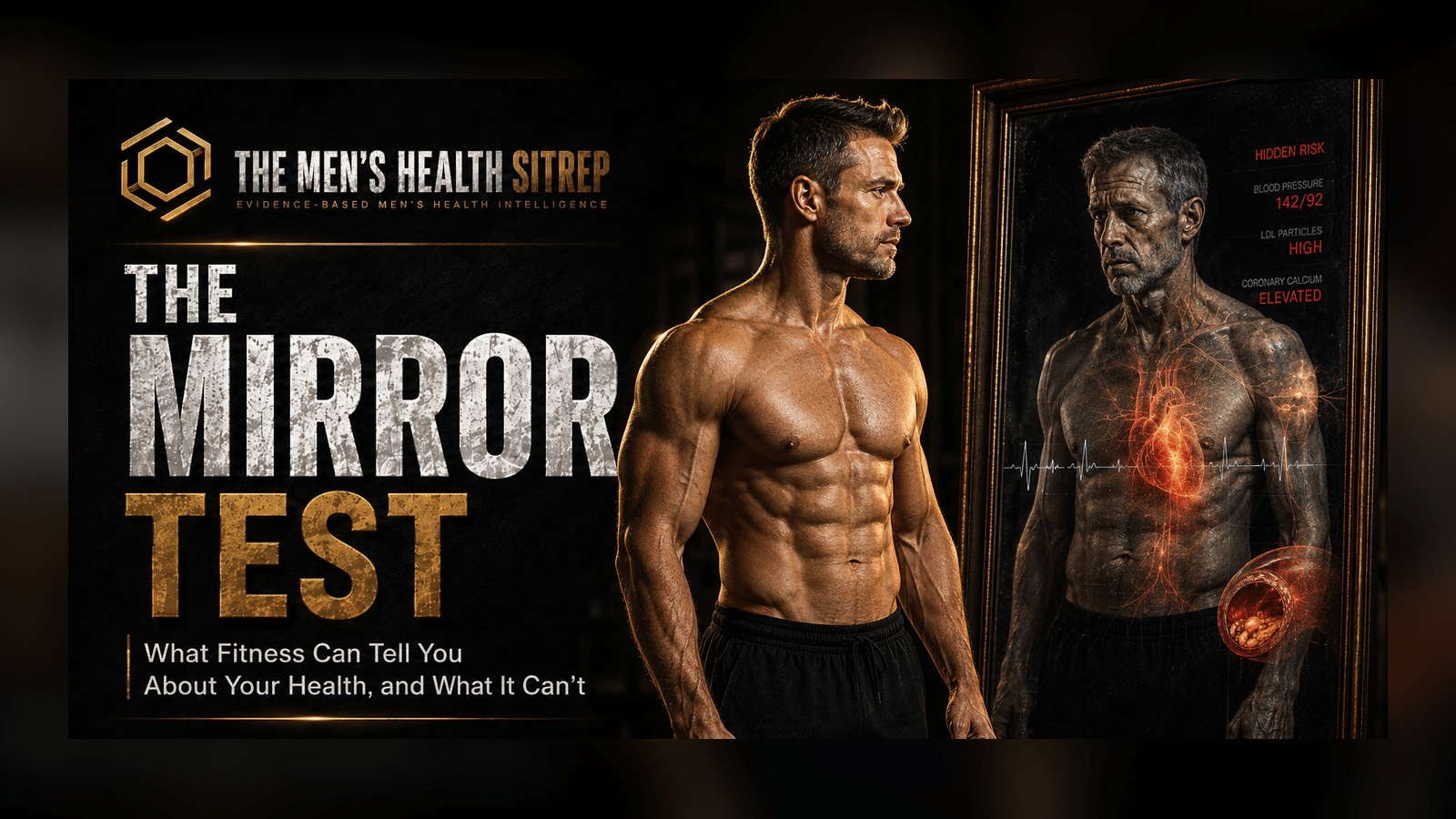
What I typically find is that a lot of men determine whether they’re healthy by looking in the mirror. I call this the mirror test.
You look in the mirror. You’re lean. You have some muscle. Maybe you can still see your abs. You run, ride a bike, swim, lift weights, or do all of the above. Your clothes fit. People tell you that you look great for your age. You feel good.
Therefore, you conclude that you’re healthy.
The problem is that the mirror test is very often wrong.
Let me explain why with a real-life patient.
The Guy Who Looked Like the Picture of Health
This gentleman was 49 years old when I first saw him. He had been a professional endurance athlete during his late teens and 20s and had been relatively successful. He had remained athletic throughout his adult life. He exercised regularly, had relatively low body fat, good muscle mass, and excellent endurance.
When people saw him walking down the street, they noticed. He was one of those guys where somebody might do a double-take and think, wow, that guy is fit and healthy. And he thought exactly the same thing.
Because of that, medical care had never been much of a priority for him. He would go to his primary care doctor for an annual physical, although sometimes he would skip a year. His doctor would check his blood pressure and run the standard tests. When I asked him what his blood pressure normally ran, he had no idea. He had simply always been told that it was “fine.”
They would do some basic labs. Nothing remarkable had ever been brought to his attention. According to him, the visits were usually over in a couple of minutes. As far as he was concerned, he was a specimen of health.
He felt good. He looked good. He could physically outperform the overwhelming majority of men his age. What exactly was there to worry about?
His reason for visiting my clinic was interesting; he wasn’t coming because he believed something was wrong. Quite the opposite. He thought he was already incredibly healthy and wanted to know what else he could do to extend his lifespan.
He wanted to talk about longevity. He wanted to know what supplements he should be taking and what else he could add.
I shut down the supplement idea pretty quickly. There isn’t some stack of supplements that turns a healthy 49-year-old into an immortal 49-year-old. That’s nonsense.
What I told him instead was that before we started talking about optimizing anything, we should probably find out whether he was actually as healthy as he thought he was. In other words, let’s look under the hood.
The Muscle Car in the Parking Lot
I use this analogy with patients all the time. Imagine you’re standing at the window on the third floor of an office building looking down into the parking lot. Sitting there is an old muscle car. For guys in my age group, let’s say it’s a beautiful old Chevelle or a GTO.
From three stories up, the thing looks spectacular. The paint looks perfect. The wheels look great. The body is straight. You look down and think, man, that’s a beautiful car. So at lunchtime you decide to walk downstairs and take a closer look.
As you get closer, you start noticing things you couldn’t see from the window. You peer through the glass and the interior is torn up. The seats are ripped. The carpet is coming apart.
Then you pop the hood. The engine is covered in grime. It’s leaking oil. There are hoses cracking. Maybe there’s corrosion you couldn’t possibly have seen from three floors above.
It’s the same car you were looking at five minutes earlier. The exterior didn’t change. What changed was how much information you had.
That’s essentially what happens when you judge your health by looking in the mirror.
So that’s what we did with this patient. We popped the hood.
What We Found
I started assessing things that had simply never been assessed before. Among many other tests, I checked his lipoprotein(a), or Lp(a), which is a largely genetically determined cardiovascular risk factor. We checked apolipoprotein B, or ApoB, which gives us a measure of the concentration of atherogenic lipoprotein particles circulating in the blood. We checked fasting insulin along with a much broader metabolic evaluation.
His Lp(a) was approximately 200 mg/dL. That’s high. His ApoB was around 160 mg/dL, also high. His fasting insulin was approximately 25 μIU/mL, which was substantially higher than I wanted to see. Then I hooked up the ECG.
He was in atrial fibrillation. That’s a real problem…..
I performed echocardiography and found something else. His ascending aorta measured approximately 4.6 centimeters, a clinically important dilation. And when I looked at his aortic valve, it was bicuspid. Instead of the usual three valve leaflets, he had two, a congenital abnormality that is associated with aortic valve disease and dilation of the ascending aorta.
Here’s why that combination matters. The aorta is the main artery carrying blood out of your heart to the rest of your body, and the wall of it is only built to stretch so far. Once it dilates the way his had, that wall is measurably weaker, and the real danger is that it eventually tears or ruptures, which is a sudden, life-threatening emergency with little or no warning. A bicuspid valve tends to go hand in hand with that same weakening, and it also wears out faster than a normal three-leaflet valve, since it’s carrying the same workload with less structure behind it.
At 49 years old, with his aorta already at that size, this almost certainly means open heart surgery at some point down the road, either to replace the valve, repair the aorta, or both, before it reaches a size where the risk of tearing becomes too high to just keep watching.
Remember, this man was 49 years old, exercising regularly and feeling fine.
We weren’t done. We obtained a coronary artery calcium scan. His calcium score was 210. At 49 years old, that represents a very meaningful amount of established coronary atherosclerosis. We subsequently found that he also had obstructive sleep apnea.
Then there was his blood pressure. Once we actually started measuring it repeatedly rather than accepting that it had always been “fine,” his systolic pressures were routinely in the 140s and 150s.
Think about what had just happened. This guy walked through my door believing he was a specimen of health. Anyone who saw him would have agreed with him. Lean, fit, strong, exercising constantly, feeling great, no complaints. That was the man who walked in.
By the time we finished looking under the hood, we found something else entirely. This was the type of guy who drops dead on the golf course, and everyone who knew him says the same thing. Did you hear about John? He’s dead. My god, he looked great.
That’s the man who walked out of my office that day. Not the one who walked in. We had looked under the hood, and he was far from healthy. Looked great in the mirror…could do a sub-3-hour marathon, but far, far from healthy.
He was floored. His response was basically, how is this possible? I exercise. I eat well. I’m lean. I do all the right things.
And that’s the entire point of this article.
A 49-year-old who looked and felt like the picture of health was carrying atrial fibrillation, a dilated aorta, a bicuspid valve, and significant coronary plaque. All of it was invisible from the outside.
Exercise Really Is That Important
Before somebody misunderstands what I’m saying here, I want to make something very clear. Exercise is probably one of the most powerful things you can do to improve your health.
I’m not minimizing exercise. I’m doing exactly the opposite.
If you take somebody who is overweight and sedentary, then get that person exercising, the physiologic effect can be enormous. It’s not a trivial intervention. In some people the change is almost unbelievable. And the scientific literature supporting exercise is massive.
Cardiorespiratory fitness
Higher cardiorespiratory fitness is one of the strongest predictors we have of long-term health and survival. In a major meta-analysis, every 1-MET increase in cardiorespiratory fitness was associated with approximately a 13% reduction in all-cause mortality and a 15% reduction in cardiovascular events. More recent systematic evidence involving more than 20 million observations has continued to show a strong, graded relationship between cardiorespiratory fitness and mortality. [1,2]
That matters. If you’re 55 years old with an excellent VO2 max, that’s a very good thing.
One thing worth being direct about here. Cardiorespiratory fitness improves your odds. It does not prevent a heart attack, and it does not reverse atherosclerosis, the cholesterol-driven plaque buildup that damages and narrows your arteries. A high VO2 max does not undo elevated Lp(a) or ApoB, and it doesn’t erase plaque that’s already there. Studies of highly fit athletes have found significant coronary atherosclerosis despite excellent fitness and favorable risk profiles, which is exactly the point. [9,10]
Muscle and strength
Maintaining muscle and strength becomes increasingly important as we age. Resistance training helps preserve skeletal muscle, strength, and physical function. Muscle-strengthening activity is also associated with lower rates of all-cause mortality and several major chronic diseases. A 2022 systematic review and meta-analysis found approximately a 10% to 17% lower risk across several major outcomes among people participating in muscle-strengthening activities. [3]
Again, if you’re 60 years old and strong, that’s a good thing. I would much rather see that than the alternative.
Glucose metabolism and insulin sensitivity
Exercise increases skeletal-muscle glucose uptake and improves insulin sensitivity. Skeletal muscle is one of the major destinations for glucose after a meal, and regular exercise improves the body’s ability to handle that glucose. [4]
Blood pressure
Regular exercise can lower blood pressure, and weight loss can lower blood pressure in people carrying excess weight. Both are important parts of treating and preventing hypertension. But I want to be careful with how we say that, because the magnitude matters.
The average reduction from exercise is generally measured in single-digit millimeters of mercury, not 20, 30, or 40 points. In a recent meta-analysis of patients with hypertension, for example, approximately 150 minutes per week of aerobic exercise was associated with an average systolic reduction of about 7 mmHg. Other analyses show somewhat different reductions depending on the type of exercise and the population studied. Weight loss produces a similar pattern: meaningful reductions, but generally on the order of several systolic points on average rather than dramatic normalization of severe hypertension. [5,6]
That’s clinically important. Moving somebody from 138 to 131 is useful. But not enough.
We shouldn’t take that evidence and tell a lean, active guy whose systolic blood pressure is routinely in the 150s that he simply needs to exercise more. Some people can absolutely make sufficient lifestyle changes that medication is no longer necessary, particularly when excess weight, inactivity, alcohol intake or other modifiable factors are major contributors. But plenty of people cannot. Genetics, vascular aging, renal physiology and many other factors contribute to hypertension.
My patient was already lean. He was already exercising extensively. Telling him to exercise more wasn’t going to adequately address systolic pressures repeatedly running in the 140s and 150s. That’s exactly why blood pressure has to be measured rather than inferred from someone’s lifestyle or appearance.
Visceral fat
Another major benefit of regular exercise is its effect on visceral fat. This is different from simply talking about how much fat you can pinch around your waist or whether you can see your abdominal muscles. Visceral adipose tissue is the fat stored deeper in the abdomen around the internal organs, and it is considerably more metabolically active than ordinary subcutaneous fat.
Excess visceral fat is associated with insulin resistance, abnormal glucose and lipid metabolism, systemic inflammation and increased cardiometabolic risk. Adipose tissue isn’t simply an inert storage tank for calories. Particularly when visceral adipose tissue expands, it participates in inflammatory signaling and metabolic dysfunction. [7]
Exercise is very effective at reducing visceral fat. Importantly, studies have demonstrated reductions in visceral adipose tissue from exercise even without a hypocaloric diet, and meta-analytic data suggest a dose-response relationship in which greater amounts of aerobic exercise generally produce greater reductions in visceral fat. [8]
So when somebody goes from being sedentary and carrying a large amount of abdominal visceral fat to exercising regularly and losing that fat, that can represent a major improvement in metabolic health. Again, this is one of the enormous benefits of exercise. It just doesn’t tell us what is happening everywhere else.
Physical reserve
Exercise also gives you something that becomes incredibly important later in life: reserve. You can climb stairs. You can pick something heavy up off the floor. You can travel. You can get off the ground. You can recover from illness or surgery with a larger physiologic reserve than somebody who has spent the previous 30 years sitting in a chair.
Exercise is one of the most powerful things you can do for your health. It just cannot rule out everything else that might be going wrong.
What the Mirror Can’t See
The easiest way to understand this is to ask what information you’re actually getting when you look in the mirror. You can see body composition reasonably well. You can see muscle. You can see whether somebody is carrying a large amount of excess body fat.
If you exercise with that person, you may also learn something about his performance. Maybe he can run a seven-minute mile. Maybe he can ride a bike up a mountain. Maybe he can squat 300 pounds. Those are meaningful pieces of information. But here’s what you can’t see.
You can’t see atherosclerosis
You have no idea whether there is plaque growing inside the coronary arteries. My patient couldn’t see his calcium score of 210 when he looked at his abs.
And this isn’t merely theoretical in athletes. Studies of masters endurance athletes have demonstrated coronary calcium and coronary plaque in some highly trained men despite excellent fitness and otherwise favorable risk profiles. This does not mean endurance exercise is bad for the heart. The overwhelming body of evidence supports the health and survival benefits of exercise. It demonstrates something much simpler: excellent athletic performance does not prove the absence of coronary atherosclerosis. [9,10]
You can’t see ApoB or Lp(a)
You can’t look at somebody’s waistline and determine how many atherogenic lipoprotein particles are circulating through his arteries. You certainly can’t see Lp(a). Lp(a) is predominantly genetically determined and is an independent causal risk factor for atherosclerotic cardiovascular disease. Someone can exercise his entire life, remain lean and eat an excellent diet while still having markedly elevated Lp(a). [11] You can eat clean, train hard, and stay lean for thirty years, and none of it changes what your DNA handed you.
You can’t see hypertension
You cannot look at a man’s shoulders and determine whether his blood pressure is 112/68 or 152/92. Exercise reduces the risk of developing hypertension and can lower blood pressure once hypertension is present. Weight loss can also help considerably when excess body weight is contributing. But, as we just discussed, the average reductions are generally modest relative to the degree of hypertension some people have.
My patient was exercising constantly while walking around with systolic pressures in the 140s and 150s. He didn’t look hypertensive, and there’s no such thing as a hypertensive look. You either measure it or you find out the hard way.
You can’t see an abnormal heart rhythm
Atrial fibrillation doesn’t necessarily announce itself by making somebody look sick. My patient had enough physical capacity to convince himself that his cardiovascular system was doing beautifully, while the ECG showed that he was in atrial fibrillation.
You can’t see structural heart disease
He also had a bicuspid aortic valve and a 4.6-centimeter ascending aorta. Neither one was visible in the mirror. Neither one could be diagnosed by looking at his body-fat percentage. And neither one disappeared because he had spent decades exercising.
You can’t see sleep apnea
People also associate obstructive sleep apnea almost exclusively with obesity. Obesity is certainly an important risk factor, but it is not the only one. Craniofacial and upper-airway anatomy also contribute substantially to OSA, which means lean and athletic men can absolutely have clinically important sleep apnea. [12] A six-pack tells you nothing about what’s happening in your airway once you fall asleep.
You can’t see what genetics gave you
Familial lipid disorders, elevated Lp(a), bicuspid aortic valves, cardiomyopathies and numerous other medical problems do not require somebody to look unhealthy. The same principle extends beyond cardiovascular disease. Being fit doesn’t give you immunity from cancer, kidney disease, liver disease or the many other conditions that become increasingly relevant as we age.
Exercise changes probabilities. It doesn’t grant immunity.
Fitness and Health Aren’t the Same Question
This is where I think men get confused. If you ask me whether a 55-year-old man who exercises regularly, has excellent cardiovascular fitness, maintains significant muscle mass, and has a healthy amount of visceral fat is doing something tremendously important for his health, the answer is absolutely yes. I want my patients doing exactly that.
But if you ask me whether those characteristics are enough for me to declare him medically healthy, the answer is no. They tell me something about him. They tell me quite a lot, actually. They just don’t tell me everything I need to know.
I still want to know his blood pressure, his cholesterol, and other cardiometabolic markers. I need to determine his overall risk profile. There are a lot of things happening inside the human body that don’t have the courtesy to show themselves in the bathroom mirror.
My 49-year-old patient is a nearly perfect example. He wasn’t wrong to think his fitness and body composition were beneficial. It was enormously beneficial.
Where he was wrong was assuming that his fitness meant he was healthy.
The Doctor Who Wanted a Protocol
I see a related mistake all the time, even among physicians. Once people start thinking seriously about their health, they often jump immediately to what they can add. What supplement should I take? What peptide should I use? What’s the new longevity protocol? What else can I put into the equation that will make me healthier? It’s like adding a supercharger to an engine nobody’s checked the oil in.
Years ago, I had a patient who was himself a physician. He came to me and said he wanted to sign up and follow our “protocols.” That was the word he kept using: protocols. He wanted to know about the protocols.
What he seemed to be looking for was something he could add. Maybe supplements. Maybe peptides. Maybe some complicated anti-aging regimen that sounded cutting-edge. Instead, I told him, listen, there isn’t some magical protocol.
Before we start trying to optimize anything, we need to find out what’s actually going on, the same ground we already covered with the case above: his blood pressure, his lipids, his metabolic health, whether he’s sleeping normally, whatever might be developing quietly in the background. In other words, we need to look under the hood.
And at the same time, we need to get the fundamentals right. That part is usually much less exciting. Go to bed and wake up at reasonably consistent times. Deliberately protect your sleep. Keep the room dark, cool and quiet. Don’t drink excessive alcohol, particularly before bed. Set aside time to exercise just like you set aside time for work or anything else that matters. Train with a purpose. Build cardiorespiratory fitness. Preserve muscle and strength. Don’t chronically overeat. Get adequate protein. Maintain a healthy body fat level. Pay attention to the chronic stress in your life. That’s the protocol. Apparently, it wasn’t a very exciting one.
What was even more interesting was that when I explained to him the problems I saw in his lab results and the things I thought we should address now to reduce the likelihood of disease showing up ten or twenty years down the road, he seemed considerably less interested in that discussion.
And that’s the problem.
People can look good in the mirror, believe they are “healthy,” and become fascinated with optimization. They want the new supplement, the peptide, the complicated protocol, something novel they can add. Meanwhile, they may not know their blood pressure, their ApoB, whether they have sleep apnea, or whether coronary disease has already begun developing. Putting a fresh coat of paint on the car doesn’t tell you what condition the engine is in.
The fundamentals matter enormously, and exercise belongs near the top of that list. But this is where the distinction between necessary and sufficient becomes useful.
Exercise is a necessary component of a serious long-term health strategy. It is not sufficient for health. Think about that for a second.
You can exercise correctly and still have hypertension. You can sleep well and still have elevated Lp(a). You can eat an excellent diet and still develop coronary atherosclerosis. You can do virtually everything right from a lifestyle standpoint and still have a bicuspid aortic valve, atrial fibrillation, cancer, or any number of other problems that don’t care how disciplined you are.
That’s why the goal isn’t to find the perfect protocol or to look good in a mirror. The goal is to know what’s actually happening in your body, address what needs to be addressed, and then consistently do the basic things we already know improve health. That’s a lot less exciting than a new peptide, but it’s a lot more important.
Don’t Be Fooled by the Mirror
So the bottom line is pretty simple.
Don’t be fooled by the mirror, and don’t be fooled by the guy running down the bike path with his shirt off who looks like he’s in phenomenal shape. Maybe he’s incredibly healthy, and maybe he is not. You have no idea, and more importantly, neither does he, unless somebody has taken the time to look.
The mirror can tell you you’re lean.
The gym can tell you you’re strong.
The bike can tell you you’re fit.
None of them can tell you whether your arteries are clean, whether your heart is beating the way it should, or whether something is quietly building that will eventually demand your attention on its own terms, whether you’re ready for it or not.
You have to pop the hood.
Two men can look nearly identical on the outside and be living in completely different bodies on the inside.
References
-
Kodama S, et al. Cardiorespiratory fitness as a quantitative predictor of all-cause mortality and cardiovascular events in healthy men and women: a meta-analysis. JAMA. 2009;301:2024-2035.
-
Lang JJ, et al. Cardiorespiratory fitness is a strong and consistent predictor of morbidity and mortality among adults: an overview of meta-analyses representing over 20.9 million observations. Br J Sports Med. 2024.
-
Momma H, et al. Muscle-strengthening activities are associated with lower risk and mortality in major non-communicable diseases: a systematic review and meta-analysis of cohort studies. Br J Sports Med. 2022;56:755-763.
-
Kanaley JA, et al. Exercise/physical activity in individuals with type 2 diabetes: a consensus statement from the American College of Sports Medicine. Med Sci Sports Exerc. 2022.
-
Ganjeh BJ, et al. Effects of aerobic exercise on blood pressure in patients with hypertension: a systematic review and dose-response meta-analysis of randomized trials. 2024.
-
Yang S, et al. Effect of weight loss on blood pressure changes in overweight patients: a systematic review and meta-analysis. 2023.
-
Kawai T, et al. Adipose tissue inflammation and metabolic dysfunction in obesity. Am J Physiol Cell Physiol. 2021.
-
Recchia F, et al. Dose-response effects of exercise and caloric restriction on visceral adiposity in overweight and obese adults: a systematic review and meta-analysis of randomized controlled trials. 2023.
-
Merghani A, et al. Prevalence of subclinical coronary artery disease in masters endurance athletes with a low atherosclerotic risk profile. Circulation. 2017;136:126-137.
-
Aengevaeren VL, et al. Relationship between lifelong exercise volume and coronary atherosclerosis in athletes. Circulation. 2017;136:138-148.
-
Reyes-Soffer G, et al. Lipoprotein(a): a genetically determined, causal, and prevalent risk factor for atherosclerotic cardiovascular disease. Arterioscler Thromb Vasc Biol. 2022;42.
-
Neelapu BC, et al. Craniofacial and upper airway morphology in adult obstructive sleep apnea patients: a systematic review and meta-analysis of cephalometric studies. Sleep Med Rev. 2017;31:79-90.