Should You Trust What Ben Bikman Says?
By Christopher Piercecchi, MD — Physician and Wellness Manager, Founder,
…
A traditional annual medical visit will tell you what’s wrong today. Our Wellness Planning service is different. It is designed to show you what is going on inside your body today that may become a problem down the road—what may eventually contribute to disease or early death.
We take a detailed look at your current health, medical and family history, physiology, lifestyle, and goals; use targeted testing and imaging to identify disease or emerging risk before it becomes obvious; and then translate those findings into a physician-developed plan for prevention, performance, and long-term health.
Much like a financial planner analyzes your finances and builds a detailed plan to protect your financial health over the years, we apply the same philosophy to your health and wellness.
Wellness Planning gives you a clearer view of where your health is headed—and a plan for what to do about it.
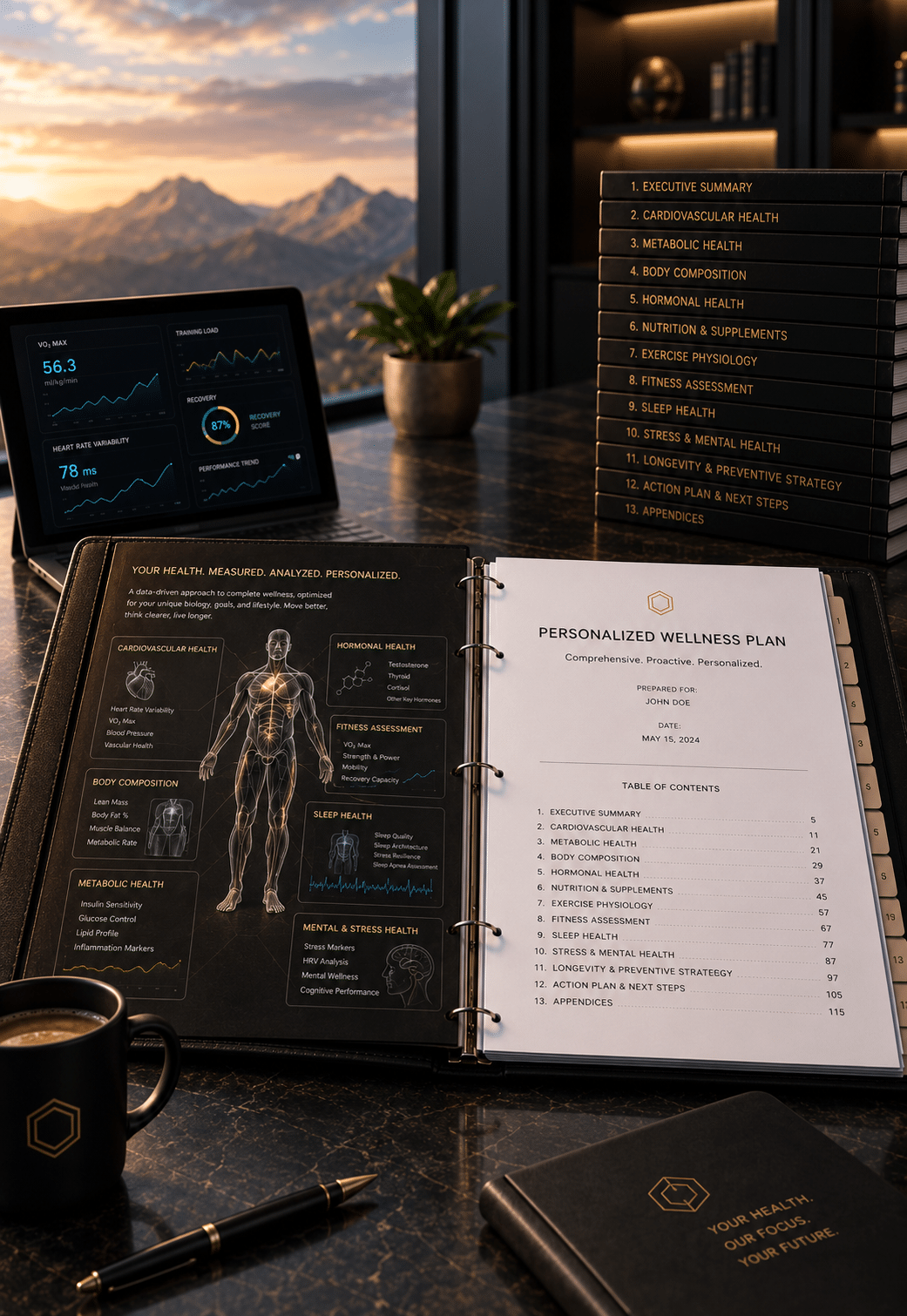
Wellness Planning is a comprehensive, physician-led audit of your health. It goes beyond looking for problems that already exist. We take a deeper, more investigative approach to understand what is happening now, what may be developing beneath the surface, and what could influence your health in the years ahead.
That matters because feeling well does not always mean everything is well. Many of the conditions that eventually affect a man’s health begin quietly, long before symptoms appear. Our process is designed to uncover those early signals by looking at your health as a whole, bringing together your history, physiology, lifestyle, testing, and individual risk to understand not just where you are today, but where you may be headed.
We then turn that understanding into a personalized Wellness Plan. It defines what deserves attention, what should be monitored, and what you can do now to improve your trajectory. The result is more than an evaluation or a set of test results. It is a practical roadmap for protecting your health, maintaining your performance, and staying well over the long term.
Your evaluation establishes the foundation for your Wellness Plan.
We develop a detailed picture of your current health, identify important current and future risks, measure key aspects of your physiology and physical capacity, and determine where intervention is most likely to improve or protect your health.
A detailed, physician-designed examination focused on men’s health, prevention, cardiovascular risk, physical function, and healthy aging.
This is intentionally different from the routine annual physical most men have experienced.
The traditional doctor’s-office physical examination has changed remarkably little over the years and often provides limited information about how well a man is actually aging.
Drawing on my background as a physician and former cardiothoracic surgeon, I developed what we call the Next-Generation Physical Examination, a more detailed and highly individualized approach to physical examination.
Your examination is interpreted in the context of everything else we are learning about you, including your laboratory testing, cardiovascular evaluation, body composition, metabolism, sleep, fitness, and physiology.
The goal is to make the physical examination a meaningful part of understanding your health rather than simply another annual ritual.
An extensive men’s health-specific laboratory evaluation, including advanced cardiovascular, metabolic, hormonal, nutritional, and intracellular micronutrient assessment, designed to identify disease, risk, and physiologic abnormalities beyond routine bloodwork.
Routine laboratory testing was never designed to answer all of the questions we are asking in Wellness Planning.
Over the years, I have developed a men’s health-specific laboratory evaluation designed to look much more deeply at the systems that influence long-term health, disease risk, physical function, and how well a man is aging.
Rather than simply determining whether a handful of standard laboratory values fall inside a reference range, I use your testing to build a more complete picture of cardiovascular and metabolic risk, hormonal health, thyroid function, inflammation, nutritional status, inherited risk, organ function, and men’s preventive health.
Your nutritional assessment also includes intracellular micronutrient testing, giving us additional information about selected vitamins, minerals, antioxidants, and other nutrients relevant to nutritional status.
Testing is individualized and ordered with a purpose. We are looking for information that can help us identify risk earlier, understand your physiology more clearly, and make better decisions about what you should actually do.
DEXA allows us to objectively measure visceral fat, body fat, lean mass, and skeletal muscle rather than relying on body weight or BMI alone.
Body weight and BMI tell us relatively little about what your weight actually consists of.
DEXA allows us to objectively measure total and regional body fat, visceral abdominal fat, lean mass, skeletal muscle mass, and other important aspects of body composition.
Those measurements become increasingly important as men age.
Excess visceral fat is associated with metabolic and cardiovascular risk, while loss of skeletal muscle and physical reserve contributes to frailty, declining function, and loss of independence later in life.
Your DEXA establishes an objective body-composition baseline that becomes part of your nutrition, exercise, metabolic-health, and healthy-aging strategy.
Your nutrition strategy is built around your actual physiology, including direct measurement of your resting metabolic rate rather than relying solely on generic calorie formulas.
Metabolic health is much more than a glucose level or a number on the scale.
We evaluate your laboratory findings, insulin and metabolic health, body composition, nutritional habits, activity level, health risks, and goals, then combine that information with an actual physiologic measurement of how much energy your body requires.
Resting Metabolic Rate Testing
As part of the protocol, we directly measure your resting metabolic rate.
This is not simply a calculator or generic equation based on your age, height, and weight. You undergo physiologic testing that measures your actual resting energy expenditure and gives us a much better understanding of how many calories your body requires at rest.
We then integrate your measured metabolism with your DEXA body composition, laboratory findings, exercise demands, and individual goals to build your nutritional strategy.
Depending on your needs, that may include recommendations for calorie intake, protein requirements, fat loss, weight management, preservation or development of lean muscle, exercise fueling and recovery, cardiometabolic health, and long-term healthy aging.
The nutritional strategy is built around your measured metabolism, your body composition, your physiology, your health risks, and your goals.
Your cardiovascular imaging, laboratory data, blood pressure, inherited risk, and metabolic health are personally integrated and interpreted by a physician who previously practiced cardiothoracic surgery.
Cardiovascular disease can develop silently for decades before producing symptoms.
My background is in cardiothoracic surgery. I spent years directly treating advanced cardiovascular disease and seeing what happens when coronary and vascular disease has progressed far enough to require major intervention.
I personally analyze your cardiovascular findings and integrate the imaging, laboratory data, blood pressure, family history, inherited risk, metabolic health, lifestyle, and other relevant information into an individualized prevention strategy.
Depending on your age, history, and individual risk, your evaluation may include:
These are not isolated tests that simply generate reports. They are interpreted together in the context of your complete health picture.
A one-on-one assessment with an experienced fitness professional, followed by a customized exercise program designed specifically for your health, age, abilities, limitations, and goals.
Physical function is one of the most important components of healthy aging, and simply telling someone to “exercise more” isn’t an adequate fitness plan.
Your evaluation includes a one-on-one assessment with a personal trainer and fitness professional who understands the changing physical needs of men as they age, including strength, mobility, balance, conditioning, injury limitations, and preservation of long-term physical capacity.
Your assessment identifies your current strengths, weaknesses, limitations, movement capacity, and overall fitness.
From that assessment, you receive a personalized exercise program built specifically for you, with recommendations addressing strength training, cardiovascular conditioning, mobility, functional movement, areas of weakness or limitation, and goals specific to your health and current ability.
In practical terms, you receive professional fitness assessment and a customized workout strategy rather than generic advice about exercise.
Advanced physiologic testing similar to what is used in athletic performance settings, followed by a dedicated consultation with a sports physiologist who interprets your results and provides individualized training recommendations.
Functional fitness helps us understand what you can do. Exercise physiology helps us understand how your body performs while doing it.
Your OptiFit evaluation uses advanced physiologic testing similar to the type of assessment used in athletic performance settings.
Testing may evaluate:
You do not simply receive a test report.
After testing, you receive a dedicated virtual consultation with a sports physiologist who analyzes your findings in detail, explains what they mean, identifies your physiologic strengths and limitations, and provides specific recommendations for how you should train.
Those findings are then integrated into your overall fitness and cardiovascular strategy.
Whether your goal is longevity, improved endurance, better cardiovascular fitness, or higher athletic performance, your exercise recommendations can be based on your measured physiology rather than generic age-based formulas.
A multi-night home sleep evaluation designed to identify sleep apnea and other important sleep abnormalities, with appropriate physician interpretation and specialist involvement when indicated.
Sleep is treated as an important medical component of your health rather than simply asking whether you feel tired.
Your Wellness Planning evaluation includes a multi-night home sleep study designed to evaluate for sleep apnea and other important sleep abnormalities.
The results receive medical interpretation, and when appropriate you may also receive a dedicated virtual consultation with a pulmonary/sleep medicine physician to review the findings and discuss appropriate treatment.
The results are then incorporated into your Wellness Plan alongside your cardiovascular health, metabolism, body composition, hormones, fitness, and other relevant findings.
If additional follow-up testing or ongoing treatment management is required after the Wellness Planning process is complete, those recommendations will be clearly identified for you.
We establish a detailed picture of your current health, risks, physiology, and physical capacity using the history, examination, testing, and imaging that are appropriate for you.
Your physician brings the findings together and determines what they mean as a whole – not simply whether individual numbers or tests are normal or abnormal.
We identify the issues that matter most, establish priorities, and develop specific recommendations based on your findings, risks, and goals.
Once your Wellness Plan is complete, we meet again to walk through the findings, explain the recommendations, answer your questions, and establish your next steps.
Testing is only useful if it changes decisions. Once your evaluation is complete, I review and integrate everything we have learned into a personalized Wellness Plan that identifies what matters most, establishes priorities, and lays out what I recommend doing next.
There is no standard plan that every patient receives. Your recommendations are shaped by your individual findings and grounded in established physiology, objective measurement, clinical evidence, and medical judgment—not supplement stacks, experimental treatments, or whatever happens to be popular in longevity medicine at the moment.
We then meet for a detailed regroup, where I walk you through the findings, explain what they mean, review my recommendations, and answer your questions. The goal is for you to leave with a clear understanding of where your health stands, what deserves attention, and what you can do to protect and improve it going forward.
Know where you stand. Know what to do next.
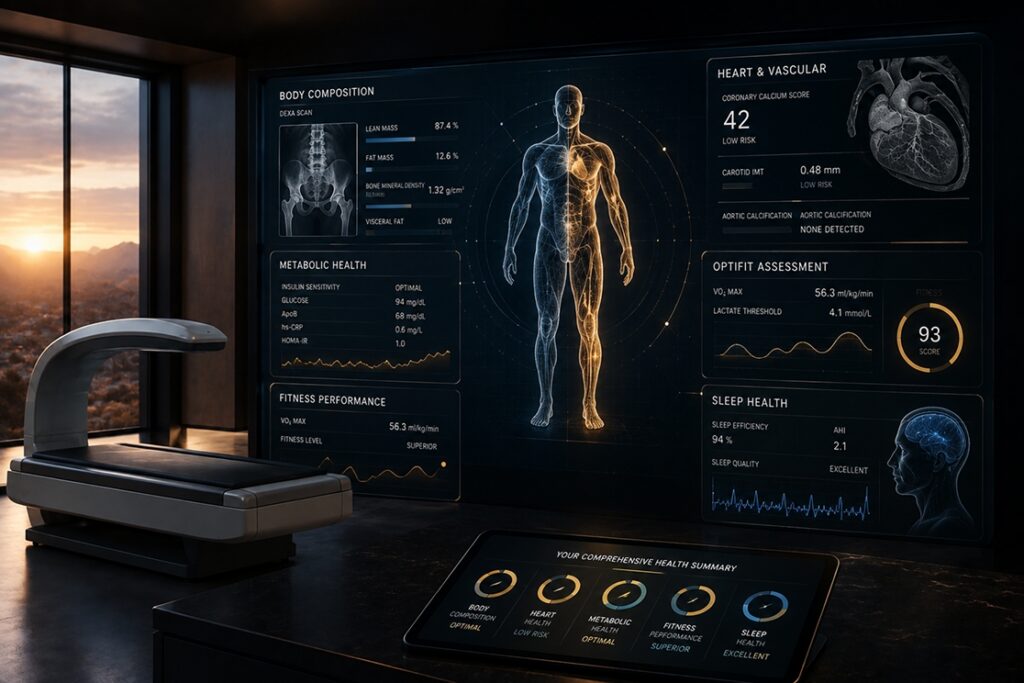
A one-time evaluation and planning process that includes physician interpretation, a personalized Wellness Plan, and a detailed regroup. You leave with the roadmap and decide how you want to implement it.
The same foundation, with ongoing physician involvement throughout the year, including progress review, medical management, repeat testing, Wellness Audits, and adjustments to your plan over time. We help you implement and manage the roadmap.
Learn About Wellness Management
Wellness Planning is designed for men who want a much deeper understanding of their health than a traditional annual physical can provide. We look for disease and risk before they become obvious, measure the areas of your health and physiology that matter, bring the findings together into one complete picture, and develop an individualized strategy for what should happen next. You leave understanding your health in unusual depth and with a clear physician-developed plan for the future.
Contact Us!
By Christopher Piercecchi, MD — Physician and Wellness Manager, Founder,
…He writes The Men’s Health SITREP, cutting through wellness hype and influencer claims with peer-reviewed evidence.
SUBSCRIBE FREE