
By Christopher Piercecchi, MD — Physician and Wellness Manager, Founder, The Men’s Clinic for Wellness & Vitality
This SITREP is for general education only. It does not diagnose, treat, or replace individualized medical care. Talk to your own physician about your sleep and your health.
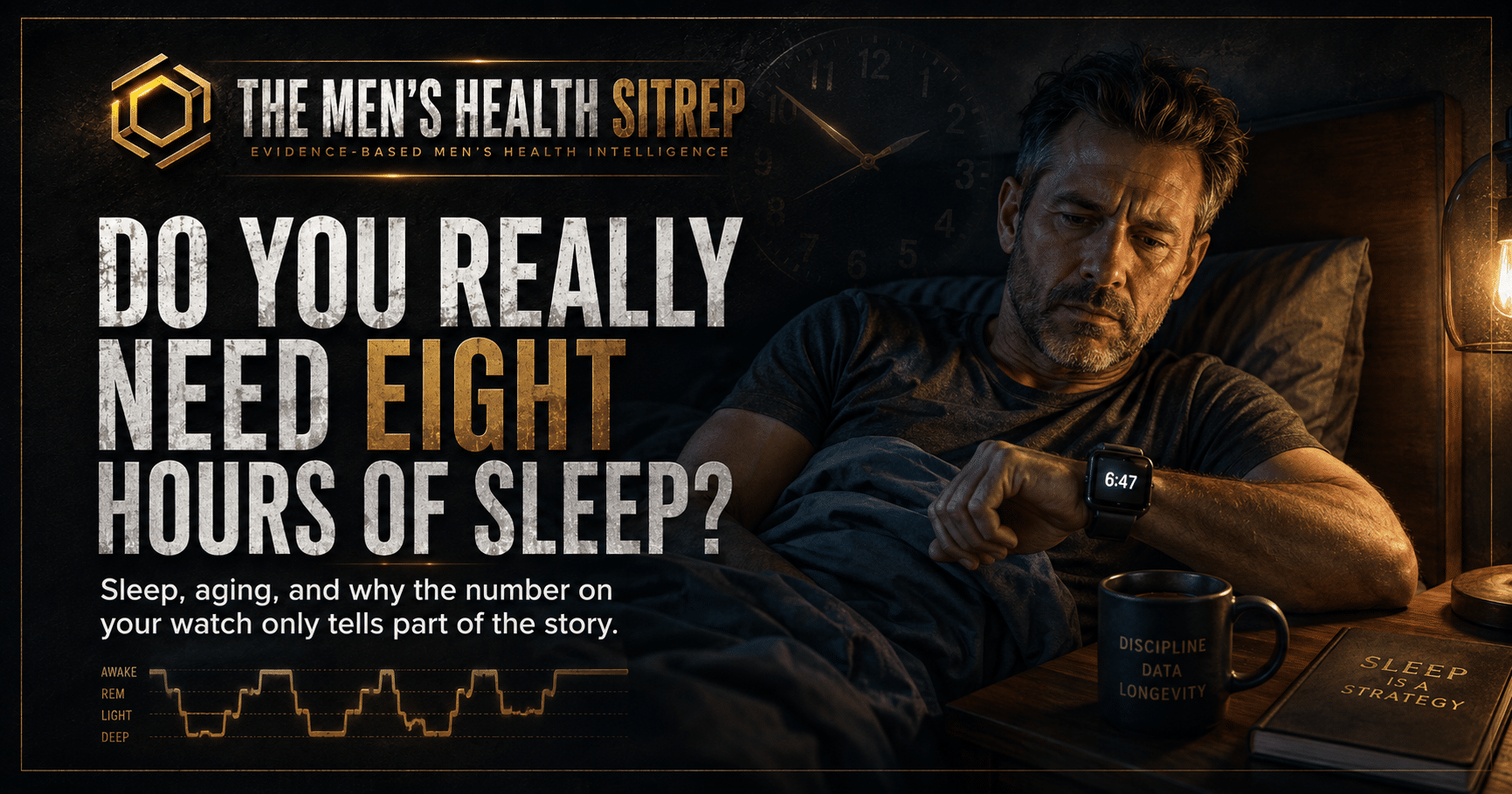
Eight hours has become one of those health recommendations that almost everyone knows. We hear it from doctors, read it in health articles, and now see it built directly into the targets on watches and sleep trackers. The result is that many people have started treating eight hours almost like a benchmark. You wake up, look at your watch, see that you slept six hours and forty-seven minutes, and there is an immediate sense that you came up short. Seven hours and fifteen minutes may have felt perfectly adequate until the device informed you otherwise.
There is no question that sleep matters. Consistently depriving yourself of it affects energy, alertness, mood, metabolic function, cardiovascular physiology, and many other aspects of health. The more interesting question is whether the evidence really supports the precision we have attached to the number eight. Does an adult who sleeps seven hours and feels well need to find another hour somewhere? Is nine hours even better? Does sleep requirement change as we get older? Several recent studies have given us a much better look at those questions, including an unusually large study published in Nature in May 2026.
A New Way of Looking at Sleep and Aging
The 2026 Nature study came from the MULTI Consortium and used data from the UK Biobank, a research population of roughly 500,000 people. Rather than simply comparing sleep duration with whether someone later developed heart disease or diabetes, the investigators examined sleep in relation to 23 different measures of biological aging involving the brain and multiple organ systems. Those measures were derived from MRI and other imaging, circulating blood proteins, and metabolic markers.[1]
The idea of a biological aging clock can sound more complicated than it is. Chronological age tells us how long someone has been alive. Biological-aging models try to determine whether measurements within the body resemble what researchers typically see in people who are younger or older than that chronological age. Imagine two men who are both 60. One may have patterns on brain imaging, cardiovascular imaging, blood proteins, and metabolic testing that are more commonly seen in somewhat younger people, while the other may have measurements that resemble those of an older population. These clocks try to put a number on that difference. They serve as research tools, and using multiple tools simultaneously allows investigators to determine if sleep duration is consistently associated with aging across various parts of the body.
When the researchers compared those aging measurements with reported sleep duration, they did not find that biological age improved as people slept longer. Many of the relationships were U-shaped. Biological-aging measurements tended to look less favorable at the short end of sleep duration, improve through the middle, and then become less favorable again among people reporting longer sleep. Depending on the organ system being examined and whether the participant was male or female, the lowest biological-age differences generally occurred somewhere between about 6.4 and 7.8 hours of sleep.[1]
That is a very different picture from the idea that everyone should be pursuing at least eight hours, although it would be just as wrong to announce that 6.4 hours, 7.2 hours, or some other point at the bottom of one of these curves is now the scientifically proven ideal. Most of the sleep-duration data were self-reported, which means participants were estimating how much they usually slept rather than having every night measured in a laboratory. Much of the analysis also describes sleep and biological-aging measurements observed at the same general point in time. Short sleep may contribute to poorer health, but illness, pain, depression, sleep apnea, medications, and other health problems may also change how much someone sleeps. The study cannot completely separate those possibilities.[1]
The takeaway: if you consistently sleep around seven hours, wake feeling rested, and function normally through the day, there is no biological cliff waiting for you at eight hours.
The next question is what happens when we stop looking at biological-aging measurements and follow people long enough to see what actually happens to their health.
What Happens Over Decades?
The Whitehall II study gives us that longer view. This large British cohort has followed civil servants through adulthood for decades, repeatedly collecting information about lifestyle, health, disease, and sleep. In a 2022 analysis, researchers examined sleep duration when participants were approximately 50, 60, and 70 years old and then followed the development of multimorbidity, which in this study meant accumulating at least two major chronic diseases. The list included coronary heart disease, stroke, heart failure, diabetes, cancer, chronic kidney disease, depression, dementia, Parkinson’s disease, and several others.[2]
Among nearly 8,000 participants who reached age 50 without already having multiple chronic diseases, those reporting five hours of sleep or less had a 30% higher hazard of developing multimorbidity compared with those reporting seven hours, and similar associations appeared when sleep was assessed at ages 60 and 70.[2] In this context, hazard refers to the rate at which people reached that outcome during the years they were followed. It does not mean that 30% of the short sleepers became sick, or that a particular man who sleeps five hours has a 30% greater chance of developing disease. The researchers also looked specifically at people who were free of the chronic diseases being studied at age 50 and found that the short sleepers were more likely to develop a first disease and then, after that, progress to a second.[2]
Because this was an observational study, we cannot assume that sleep duration alone caused those differences. People who routinely sleep five hours may differ from seven-hour sleepers in other important ways, some of which are difficult to measure completely. Still, the pattern is difficult to dismiss, particularly because we are not talking about someone occasionally getting a bad night of sleep. We are talking about people who habitually reported very short sleep over years.
That is an important distinction in a world where sleep has increasingly become another thing to optimize. A man who sleeps seven hours and fifteen minutes, wakes without an alarm, feels good, exercises, works normally, and remains alert through the afternoon is in a very different situation from the man who gets four and a half or five hours because he stays up until midnight, wakes at 5 a.m., and has done that for ten years. The long-term evidence gives us considerably more reason to worry about the second man than to convince the first that he somehow needs to manufacture another forty-five minutes of sleep.
Other research has generally landed in the same neighborhood. A pooled analysis of more than 55,000 adults in England, Finland, and Sweden found that those sleeping approximately 7 to 8.5 hours accumulated more healthy and chronic disease-free years between ages 50 and 75 than people reporting shorter or longer sleep.[3] A separate meta-analysis involving more than 95,000 older adults again found a U-shaped relationship with mortality, although in that analysis the association was actually more pronounced among long sleepers than among short sleepers.[4]
If too little sleep is associated with poor health, it seems logical that progressively more sleep should be progressively better. That is not what these studies show, and the explanation may have as much to do with why people are sleeping longer as with the sleep itself.
When More Sleep Isn’t Necessarily Better
Some people simply sleep longer. They have done so for years, wake rested, function normally, and feel well. Nothing in these observational studies justifies telling an otherwise healthy lifelong nine-hour sleeper that he should deliberately restrict himself to seven.
The situation is different when someone’s sleep requirement changes. Consider a 65-year-old who historically slept seven hours but over the past year has started sleeping nine or ten, has difficulty getting out of bed, and remains tired during the afternoon. Longer sleep in that setting may be telling us something about his health. Depression can increase time in bed. Medications can cause sedation. Chronic illness, frailty, and neurologic disease can change sleep. Obstructive sleep apnea can produce severely fragmented sleep, leaving someone in bed for nine hours without ever obtaining nine hours of restorative sleep. As underlying illness becomes more common later in life, it becomes difficult for an observational study to determine how much long sleep contributes to illness and how much illness contributes to long sleep.
Whitehall II provides an interesting clue. Longer sleep was associated with multimorbidity when measured later in life, particularly around ages 60 and 70, while the signal was less convincing at age 50.[2] That does not prove that illness caused the longer sleep, but it is one reason I would pay much more attention to someone who tells me, “I used to sleep seven hours, and now I need ten and still feel exhausted,” than to a healthy person who says he has always slept nine hours and feels excellent.
Sleep also changes naturally as we age. A 2026 review in Aging Research Reviews, covering research through the end of 2025, describes a gradual reduction in slow-wave, or deep, sleep, along with somewhat less REM sleep, more frequent transitions between sleep stages, more brief awakenings, and lower sleep efficiency, meaning that a smaller percentage of the time spent in bed is actually spent asleep. Circadian rhythms change as well, which helps explain why many older adults become sleepy earlier in the evening and wake earlier in the morning than they did when they were younger.[5]
Anyone in his 50s or 60s who remembers being able to sleep through almost anything in his 20s will recognize some of this. Waking during the night does not automatically indicate disease, and sleeping differently at 65 than you did at 25 is hardly surprising. The problem is assuming that every deterioration in sleep can be dismissed as aging. The same review estimates that insomnia affects roughly 20% to 40% of older adults and obstructive sleep apnea more than 30%.[5] Those disorders may become more common with age, but that does not make them harmless.
The takeaway: new, unexplained long sleep deserves a “why,” not congratulations for finally getting enough rest.
Eight Hours of Sleep Can Still Be Poor Sleep
Imagine two men who both report eight hours of sleep. The first falls asleep without much difficulty, progresses normally through the stages of sleep, wakes occasionally but returns to sleep, wakes feeling rested, and remains alert the following day. The second has severe obstructive sleep apnea. Throughout the night, his upper airway repeatedly narrows or closes, airflow falls or stops, oxygen levels may drop, and his nervous system repeatedly pulls him toward wakefulness just enough to reopen the airway. If his apnea-hypopnea index is 30, that process is occurring on average thirty times every hour, and many of those arousals are so brief that he has no memory of them the next morning. Both men can truthfully say that they slept eight hours, but those eight hours are very different physiologically.
Sleep and Brain Health
The brain-health literature points in the same direction. A 2025 systematic review and meta-analysis combined 76 longitudinal cohort studies examining sleep and subsequent cognitive decline or dementia.[6] Short sleep was associated with cognitive decline, but duration was only part of the picture. Long sleep, poor sleep quality, excessive daytime sleepiness, sleep-disordered breathing, and sleep-related movement disorders were also associated with adverse cognitive outcomes. One of the more striking findings was a 66% higher relative risk of Alzheimer disease among long sleepers in the pooled analysis, although the underlying studies varied considerably in how they measured sleep, which populations they studied, and how cognitive outcomes were determined. Several analyses also had substantial statistical heterogeneity, so that 66% should not be read as a precise estimate of what nine hours of sleep does to an individual person’s Alzheimer risk.[6]
A 2024 American Heart Association statement reached a similar conclusion, with one important caveat: evidence that treating a sleep disorder actually prevents dementia remains incomplete.[7] Diagnosing and treating obstructive sleep apnea matters for other reasons, but it is not yet proven to protect against cognitive decline.
So, How Much Do You Actually Need?
By this point, the original question about eight hours looks rather different from where we started. If you consistently sleep four or five hours because you simply do not allow yourself enough time to sleep, I would take that seriously. We have enough long-term evidence to say that chronic severe sleep restriction is associated with worse health, even if an observational study cannot tell us exactly how much of that risk will disappear when sleep is extended.
If you sleep around seven hours, wake rested, function normally through the day, and have no reason to suspect a sleep disorder, there is no good evidence that you need to chase another hour solely because eight has become the accepted target. If you suddenly begin sleeping nine or ten hours and still feel tired, I would want to know why. And if you snore heavily, stop breathing during sleep, wake repeatedly, wake with a dry mouth or morning headaches, or struggle to remain awake during the day, I would care much more about those symptoms than whether your tracker reported seven hours and twenty minutes or eight hours and five minutes.
So, do you really need eight hours? For many adults, probably not exactly. When large populations are studied, favorable health outcomes repeatedly cluster somewhere around seven to eight hours, sometimes extending somewhat beyond that range, and there is meaningful individual variation. What the research does not support is treating eight hours as a hard biological threshold that every adult must reach every night.
The takeaway: pay attention to the hours. Just don’t mistake the number for the whole story.
References
-
The MULTI Consortium, O’Toole CK, Song Z, et al. Sleep chart of biological ageing clocks in middle and late life. Nature. Published May 13, 2026. doi:10.1038/s41586-026-10524-5.
-
Sabia S, Dugravot A, Léger D, et al. Association of sleep duration at age 50, 60, and 70 years with risk of multimorbidity in the UK: 25-year follow-up of the Whitehall II cohort study. PLoS Med. 2022;19(10).
-
Stenholm S, Head J, Kivimäki M, et al. Sleep duration and sleep disturbances as predictors of healthy and chronic disease-free life expectancy between ages 50 and 75: a pooled analysis of three cohorts. J Gerontol A Biol Sci Med Sci. 2019;74(2):204-210.
-
He M, Deng X, Zhu Y, Huan L, Niu W. The relationship between sleep duration and all-cause mortality in the older people: an updated and dose-response meta-analysis. BMC Public Health. 2020;20:1179.
-
Alhajaji R, Jahrami H, Pandi-Perumal SR, BaHammam AS. Sleep health in the older adults: architecture, circadian changes, and common sleep disorders. Ageing Res Rev. 2026;118:103101.
-
Zhang J, Ou J, Lu X, et al. Sleep disorders and the risk of cognitive decline or dementia: an updated systematic review and meta-analysis of longitudinal studies. J Neurol. 2025;272:689.
-
Gottesman RF, Lutsey PL, Benveniste H, et al. Impact of sleep disorders and disturbed sleep on brain health: a scientific statement from the American Heart Association. Stroke. 2024. doi:10.1161/STR.0000000000000453.