
By Dr. Christopher Piercecchi, MD
Physician and Wellness Manager, Founder, The Men’s Clinic for Wellness & Vitality
This is for educational purposes only and does not constitute individualized medical advice or create a physician-patient relationship. Talk to your own physician before acting on anything you read here.
BLUF
For many men, a coronary artery calcium scan is a simple test that shows whether atherosclerosis has already begun. Calcification is a marker of established disease that has been building in the artery wall for years.[2,3]
A positive score means calcified plaque is present in at least one coronary artery. A score of zero is reassuring, but it does not prove that the arteries are free of plaque. The test is useful because the result may change how aggressively a man approaches prevention.
What the scan measures
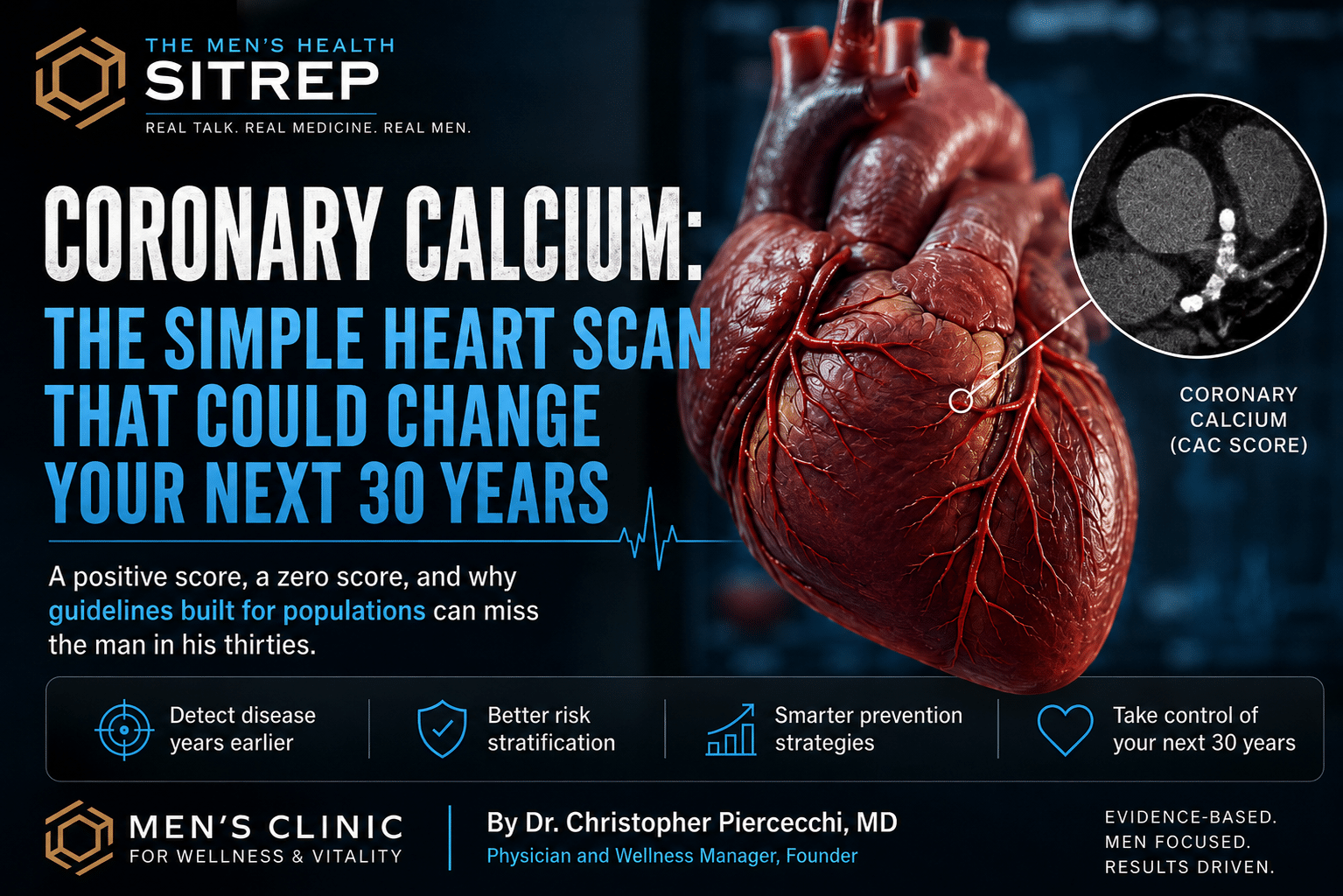
A coronary artery calcium, or CAC, scan is a specialized CT scan of the heart. Small sensors are usually placed on the chest so the scanner can time the images to the heartbeat and reduce motion artifacts. It looks for calcium within the coronary arteries, the vessels that supply the heart muscle.
The computer measures the amount and density of calcium and produces an Agatston score. A score of 0 means none was detected. Scores of 1–10 indicate a minimal amount; 11–100, a mild burden; 101–400, a moderate burden; and above 400, an extensive burden.[4,5] The score does not tell us exactly how narrow an artery is or whether blood flow is reduced. It tells us whether calcified coronary plaque exists and approximately how much is present.
Why calcium appears
Coronary disease begins when cholesterol-containing particles, particularly ApoB-containing particles, become trapped beneath the inner lining of an artery. They can trigger inflammation. Immune cells enter the arterial wall, take up cholesterol, and become foam cells. Over time, cholesterol, inflammatory cells, damaged tissue, and scar tissue accumulate into an atherosclerotic plaque.[6,7]
As plaque persists, cells become injured and die. Calcium and phosphate begin to crystallize within the damaged tissue. Some smooth-muscle cells also begin acting more like bone-forming cells and deposit hydroxyapatite, the same basic mineral found in bone.[8,9]
This is not calcium from food sticking to an artery. It is an active biological response within established plaque. Calcification begins microscopically and eventually becomes large and dense enough to be detected by CT.
A positive score therefore means atherosclerosis already exists and has progressed far enough to calcify. It does not mean an artery is critically blocked or that a heart attack is imminent. In general, however, higher calcium levels reflect a greater total burden of coronary disease and a higher future risk.[2,3]
A positive score means the disease is present. It does not necessarily mean a heart attack is coming. Most of the time, it means you have found the problem early enough to do something about it.
For paid subscribers, we will soon begin a premium series called Medical School for the Masses, where we will examine cholesterol transport, inflammation, plaque formation, calcification, and heart attacks in much greater detail.
Why finding it early matters
Heart attacks may seem sudden, but the disease behind them develops over decades. A heart attack at 65 typically reflects a disease process that began decades earlier.
The heart attack in your sixties usually began quietly in your thirties or forties.
Even a calcium score of 1 or 2 matters because the answer has changed from “we did not detect calcified disease” to “calcified coronary disease is present.” This is especially meaningful in a younger adult. In the CARDIA study, adults aged 32–46 with any detectable calcium had approximately five times the risk of fatal or nonfatal coronary heart disease during 12.5 years of follow-up compared with those who had none.[10]
Current guidelines support selective CAC testing in men beginning at age 40 when the result would help settle a prevention or treatment decision.[1] A prevention-minded man in his 30s or 40s may also reasonably choose the test, particularly with high LDL or ApoB, elevated lipoprotein(a), hypertension, diabetes, smoking exposure, kidney disease, obesity, or a family history of early heart disease.
That goes beyond routine population screening, but the logic is straightforward: if a 35-year-old already has calcium, he has premature coronary disease and would benefit from knowing it.
What a zero score means
A score of zero is good news and is associated with a much lower near-term event rate than a positive score.[2,3] It does not mean no plaque exists.
Earlier plaque may consist mainly of cholesterol, inflammatory cells, and fibrous tissue and may not yet have calcified. Microscopic calcium may also be below the scan’s resolution. In the Miami Heart Study, 16% of asymptomatic adults with a score of zero still had plaque visible on coronary CT angiography, although severe narrowing was uncommon.[11]
A zero score means, “We do not see CT-detectable coronary calcium today.” It does not mean, “You have no coronary disease and cannot have a heart attack.”
A score of zero lowers your near-term risk. It does not erase it, so your cholesterol, blood pressure, and family history still matter.
What should happen next?
If calcium is present, the response should be more deliberate prevention, not panic. That means examining LDL cholesterol, ApoB, lipoprotein(a), blood pressure, glucose control, smoking, and family history. Depending on total risk and calcium burden, cholesterol-lowering medication and other preventive therapies may be appropriate.[1]
If calcium shows up, the right response is focused prevention, not fear.
If the score is zero, one’s risk profile still matters.
The scan is often available on a self-pay basis for roughly $50–$150 and typically exposes the patient to about 1 millisievert of radiation, roughly a third of what the average person receives from natural background sources in a year.[13]
For many men, that is a reasonable tradeoff for information that may change the next 20 or 30 years of prevention.
One last point on where these recommendations come from. Guidelines are built on population data. They ask what makes sense across a large group, and they lean heavily on ten-year risk, which is driven mostly by age. That approach tends to pass over younger men, because a 35-year-old rarely carries a high ten-year risk even when disease is already forming in his arteries.
Personalized medicine works differently. It focuses on an individual, not the general population, and looks for early signs of coronary disease; knowing this now would benefit them, while decades remain to change the course. For a man in his 30s or 40s with real reasons to look, that individual answer can matter far more than the population average ever will.
Guidelines are written for the average person. You are not deciding for the average person; you are deciding what to do about your own arteries.
Two 35-year-olds
Picture two men, both 35 years old.
The first one gets a calcium scan and it shows calcium in one of his coronary arteries. Now he knows he has early coronary disease, and he knows it at an age when there is still time to do something about it. He and his physician start working on prevention. He gets his cholesterol and ApoB down, controls his blood pressure, makes the lifestyle changes that matter, and follows up regularly. Over the next several decades, all of that treatment adds up to a large reduction in his risk. He may delay a heart attack by many years, or he may prevent it from ever happening.
The second man never gets scanned. He feels fine, so he has no reason to think anything is wrong. He spends the next 25 years without the medications, the lifestyle changes, and the follow-ups that would have lowered his risk, because he never knew he needed them. At 55 or 60, he has a heart attack and ends up in the ER, and that is where he learns for the first time that he has coronary artery disease. The disease was there at 35 and might well have been detectable. He just never looked.
Both men had the same disease at 35. One of them found out in time to treat it. The other found out in the ER.
This is a simplified illustration, not a guarantee. A calcium scan doesn’t prevent heart attacks by itself; it gives you and your physician information that can change what you do next. Whether testing makes sense for you is a decision to make with your own physician.
References
-
Blumenthal RS, Morris PB, Gaudino M, et al. 2026 ACC/AHA/AACVPR/ABC/ACPM/ADA/AGS/APhA/ASPC/NLA/PCNA guideline on the management of dyslipidemia. Circulation. 2026. doi:10.1161/CIR.0000000000001423.
-
Detrano R, Guerci AD, Carr JJ, et al. Coronary calcium as a predictor of coronary events in four racial or ethnic groups. N Engl J Med. 2008;358:1336–1345. doi:10.1056/NEJMoa072100.
-
Budoff MJ, Young R, Lopez VA, et al. Ten-year association of coronary artery calcium with atherosclerotic cardiovascular disease events: the Multi-Ethnic Study of Atherosclerosis. Eur Heart J. 2018;39:2401–2408. doi:10.1093/eurheartj/ehy217.
-
Agatston AS, Janowitz WR, Hildner FJ, et al. Quantification of coronary artery calcium using ultrafast computed tomography. J Am Coll Cardiol. 1990;15:827–832. doi:10.1016/0735-1097(90)90282-T.
-
Radiological Society of North America and American College of Radiology. Cardiac CT for calcium scoring. RadiologyInfo.org. Reviewed March 25, 2024.
-
Libby P. The changing landscape of atherosclerosis. Nature. 2021;592:524–533. doi:10.1038/s41586-021-03392-8.
-
Libby P, Buring JE, Badimon L, et al. Atherosclerosis. Nat Rev Dis Primers. 2019;5:56. doi:10.1038/s41572-019-0106-z.
-
Onnis C, Virmani R, Kawai K, et al. Coronary artery calcification: current concepts and clinical implications. Circulation. 2024;149:251–266. doi:10.1161/CIRCULATIONAHA.123.065657.
-
Durham AL, Speer MY, Scatena M, Giachelli CM, Shanahan CM. Role of smooth-muscle cells in vascular calcification: implications in atherosclerosis and arterial stiffness. Cardiovasc Res. 2018;114:590–600. doi:10.1093/cvr/cvy010.
-
Carr JJ, Jacobs DR Jr, Terry JG, et al. Association of coronary artery calcium in adults aged 32 to 46 years with incident coronary heart disease and death. JAMA Cardiol. 2017;2:391–399. doi:10.1001/jamacardio.2016.5493.
-
Nasir K, Cainzos-Achirica M, Valero-Elizondo J, et al. Coronary atherosclerosis in an asymptomatic U.S. population: Miami Heart Study at Baptist Health South Florida. JACC Cardiovasc Imaging. 2022;15:1604–1618. doi:10.1016/j.jcmg.2022.03.010.
-
Aurora Health Care. Heart scan: coronary calcium scoring. Accessed July 15, 2026.
-
Messenger B, Li D, Nasir K, et al. Coronary calcium scans and radiation exposure in the Multi-Ethnic Study of Atherosclerosis. Int J Cardiovasc Imaging. 2016;32:525–529. doi:10.1007/s10554-015-0799-3.
The Men’s Health SitRep is for general educational and informational purposes only. It reviews and interprets published research. It does not constitute medical advice and does not create a physician-patient relationship. Nothing here is a substitute for individualized care from your own physician, who knows your history, your labs, and your circumstances.
A coronary calcium scan is a screening decision, not a self-diagnosis. Whether to have one, how to read the result, and what to do about it all depend on your full risk profile and should be made with your own physician. A score of zero does not rule out coronary disease, and a positive score is not by itself an emergency. The scan involves a small dose of radiation, so the decision to undergo it belongs in a conversation with your doctor. Do not start, stop, or change any medication or treatment based on what you read here.
Back to All Blogs