
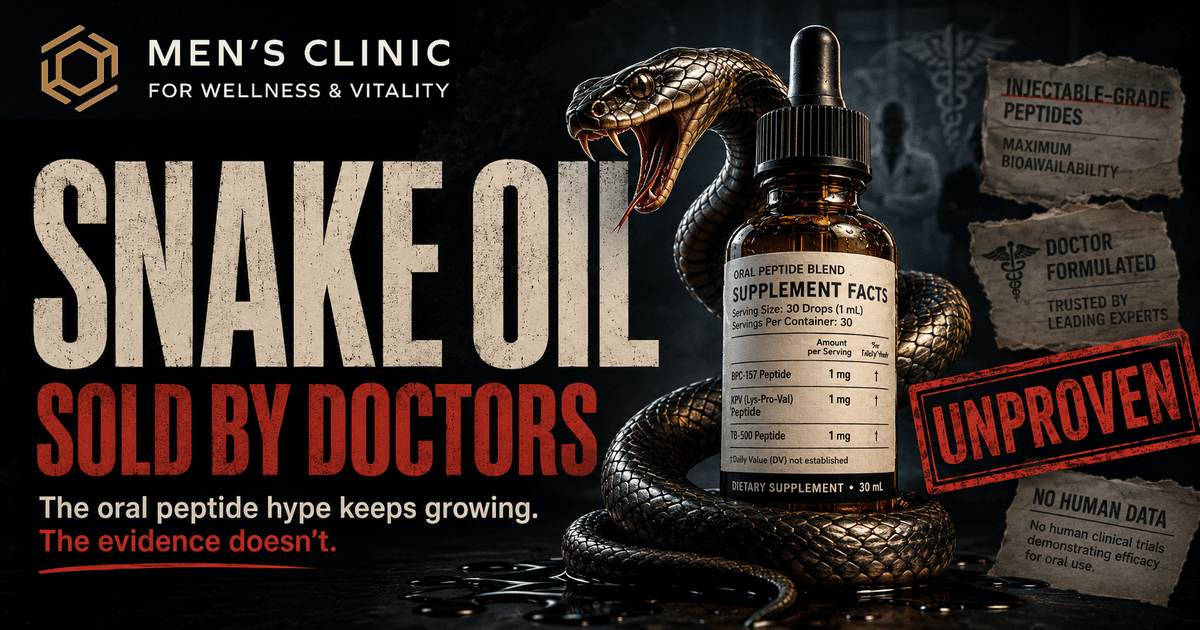
Snake Oil, Sold by Doctors

Men’s Wellness Experts in Tucson, Arizona

By Christopher Piercecchi, MD — Physician and Wellness Manager, Founder, The Men’s Clinic for Wellness & Vitality

This article is for education only and is not personal medical advice. It does not create a physician-patient relationship.

Here we go again……

A sponsored article running on The Gateway Pundit tells its readers that the medicine in their cabinet is a fraud, that the establishment has hidden the body’s real healing tools from them, and that a company called The Wellness Company has finally broken the secret open with a product called REGENERATE. The pitch is confident: thirty drops in cold water every morning, and you get “injectable-grade” doses of three peptides — BPC-157, TB-500, and KPV — with no needle, no prescription, no clinic, and no doctor in your way. It promises to rebuild your gut, calm your inflammation, heal your muscles and tendons, and get you back on your feet after an injury or surgery. A one-month bottle runs $299.99, or $269.99 if you subscribe. [1]

None of it was written by a journalist. It was a paid advertisement, and the site discloses that it makes money when you buy through the links. The entire piece is designed to read like medical information, even though it is actually a sales pitch.

First, they make you distrust the medicine

Before it sells you a drop, the advertisement goes after the medicine you already have. It tells you the anti-inflammatory drugs in your cabinet — the ibuprofen, the naproxen, the prescription NSAIDs — “don’t actually fix a single thing,” that they only mask your pain and keep you coming back for refills while a pharmaceutical executive gets rich off your suffering.

That claim is dishonest in a particular way, so let me address it directly.

The ad is right about one narrow thing: an anti-inflammatory does not regrow a torn tendon or rebuild a worn-out joint. No NSAID was ever meant to. But it stretches that one true fact into a lie — that because these drugs don’t rebuild tissue, they “don’t fix a single thing” and aren’t worth taking. That does not follow, and any physician who has treated an injured patient knows it. When you sprain an ankle or flare an arthritic joint, the pain and swelling are driven by inflammation, and NSAIDs blunt that inflammation through a mechanism understood for decades. It is a real, measurable effect — which is why national guidelines recommend topical NSAIDs as first-line treatment for acute musculoskeletal injuries, and oral NSAIDs as an option for appropriately selected patients. [2]

Are they risk-free? No, and no honest doctor would say so. Used too heavily or too long, they can irritate the stomach, cause bleeding, and strain the kidneys, which is why they belong at the lowest effective dose for the shortest time, with a physician watching. But “this medicine has real risks a doctor should help you manage” is a completely different sentence from “this medicine is a scam that does nothing.” The advertisement collapses the two because the entire sales pitch depends on you throwing out the treatment that has been studied so you will reach for the bottle that has not.

The effect is to make men in real pain distrust a proven treatment so a company can sell them an unproven one.

What the evidence actually shows

Now the product they are trying to sell you, starting with the claim that should end the conversation on its own: that you can drink these peptides and get the benefit of an injection.

Many therapeutic peptides have to be injected because the digestive tract is remarkably good at breaking them down — acid and enzymes break them into pieces, and whatever survives still has to cross the intestinal wall, which peptides do poorly. This is why conventional insulin cannot simply be swallowed, and why any credible oral peptide has to demonstrate, through human absorption studies, that a meaningful amount reaches the bloodstream intact. [3]

The Wellness Company says its “proprietary AQA delivery technology” solves this and delivers “injectable-grade” peptides orally. So ask the obvious question: where is the study? They have published no human data showing how much intact BPC-157, KPV, or TB-500 reaches the bloodstream after someone drinks these drops. A trademarked name for a delivery system is not evidence that the delivery system works.

And look at how many unproven steps are stacked inside the promise. Putting 1 milligram of a peptide into a dose does not mean 1 milligram reaches your blood. Even if some did, that would not prove it travels to the tendon that hurts. And even if it reached that tendon, it still would not prove it repairs anything. Each part of the healing process has to be demonstrated, not assumed, and the advertisement does none of that.

The peptides themselves are not supported by credible evidence, and you do not have to take my word for it, because the FDA said so in the materials it prepared for its July 2026 compounding review. For KPV and TB-500, the agency found no human clinical studies supporting the proposed uses at all — and for TB-500, no medical literature describing its use in patients for any condition, including wound healing. For BPC-157, the FDA identified only five small, methodologically limited human studies that used rectal, intra-articular, intravesical, or intravenous administration. None of them show that this oral product is absorbed or that it heals human tissue; the agency found no human data on oral absorption, and a registered oral trial has never posted results or published a paper. [4a–c]

That is the evidence base under a product sold as a whole-body regenerative breakthrough.

The company calls these ingredients “clinically researched.” That does not mean clinically proven.

A substance can be “researched” in a test tube, a mouse, a rat, or a handful of poorly controlled patients. The only question that matters to you is whether this exact oral product, at this dose, gets intact peptide into a human body and improves something real in a controlled trial. For REGENERATE, the answer is no.

The testimonials, and how the pitch works on you

In place of that evidence, the advertisement hands you testimonials. One woman says her shoulder healed in a week when nothing else worked; another says she woke up on day five with less soreness. Those experiences may be sincere. But pain comes and goes, injuries heal on their own timeline, and the placebo effect is real. People reach for a new product when they feel their worst, then credit it when they naturally drift back toward normal. A story about a shoulder cannot demonstrate tendon remodeling, gut repair, or immune regulation.

The advertisement uses four moves, and they’re the same ones every ad like this uses.

First, it gives you a villain: the pharmaceutical executive getting rich off your pain. That’s there to make you distrust anyone who might later tell you the product doesn’t work.

Second, it gives you a secret the establishment supposedly hid from you, and “freedom-minded physicians” who are finally revealing it.

Third, it sells you “no prescription gatekeepers” as freedom. But a prescription isn’t a gate someone put up to keep you down. It’s the testing and medical oversight a real treatment has to go through, and they’re bragging about skipping it.

Fourth, it uses scientific-sounding words to sound like proof when there’s no proof behind them.

The timing makes this worse

On July 23, the FDA’s Pharmacy Compounding Advisory Committee is scheduled to take up these exact three peptides, and the agency’s own scientists have already recommended that BPC-157, KPV, and TB-500 not be added to the Section 503A Bulks List — the pathway that would let a pharmacist compound them one prescription at a time when no other route applies. Their reason is the one running through this whole piece: the evidence isn’t there. [4a–d]

So consider the contradiction. The FDA’s scientists are questioning whether there is sufficient evidence to justify a pharmacist making them for one patient at a time under supervision. The Wellness Company has put all three into a single bottle and is selling it directly to the public as a finished, proven morning-routine breakthrough.

The physicians should know better

The Wellness Company puts a Chief Medical Board front and center: Peter McCullough, MD, MPH; Drew Pinsky, MD; Harvey Risch, MD, PhD; James Thorp, MD; and Kelly Victory, MD. It uses those names and credentials again and again to set its products apart from ordinary supplements on the shelf. [5]

I cannot tell from the public record which specific physician reviewed this advertisement, approved these exact claims, or is personally paid on this product, and I won’t pretend I can. But I don’t need to, to say this plainly: any physician who knowingly formulated this product, approved these claims, promoted it, or let his name and his degree be used to sell it should be ashamed. These are not laypeople who got fooled. They are doctors who know the difference between animal research and human evidence, who know oral absorption has to be measured before it is claimed, and who know that “we have no idea if this is safe” is not the same as “this is safe.” They do not get to plead ignorance. These substances are not even approved for human use! Think about that fact. And physicians are promoting these things….

The profession has already drawn the line. The AMA Code of Medical Ethics is explicit: physicians who sell or endorse health products create a financial conflict of interest, pressure patients, erode trust, and demean the profession, and should offer only products whose benefits rest on unbiased, reliable evidence while making the limits of the science clear. [6] This marketing does the opposite.

And the hypocrisy runs to the core of the pitch. The whole ad is built on the charge that Big Pharma profits by keeping you sick — and then The Wellness Company, the savior from big old bad pharma, comes in to save you by selling you a $300 bottle of REGENERATE with no clinical trial showing it works. Whatever fair criticisms exist of the drug industry, a prescription drug has to prove it works in human trials before it can make a claim on its label. REGENERATE skipped all of that and makes the claims anyway. [7] The Wellness Company wants the credibility of medicine without doing the work that earns it.

The gap is visible in the company’s own fine print. The large print promises healing and regeneration. The standard disclaimer in its supplement claims states that those statements have not been evaluated by the FDA and that the product is not intended to diagnose, treat, cure, or prevent any disease.

The large print promises to heal your tendons and repair your gut. The fine print says it isn’t meant to treat anything. The disclaimer does not erase the message used to make the sale.

A company should not be free to market an experimental product this way. Regulators can weigh the claims against the evidence, and licensing boards can weigh the conduct of any physician who knowingly attached his name or credentials to medical claims this misleading in connection with a commercial product. Whether that warrants a warning, a suspension, or the loss of a license is a matter for evidence and due process, and I won’t render that verdict from the outside. But the principle is simple: a medical license is a public trust, and it should be on the line the moment it is knowingly used to deceive the patients it exists to protect.

The bottom line

REGENERATE has no published human trial showing it heals muscle, tendon, ligament, surgical wounds, or the gut. Its central promise — that you can drink these peptides and absorb them like an injection — has never been demonstrated in humans. Two of its three ingredients have essentially no human evidence behind them. And the testimonials cannot prove healing, because a personal story never could.

This is not a medical breakthrough.

It is animal research, scientific-sounding language, anti-pharma anger, and physician authority, assembled into a sales pitch.

The wellness industry keeps making bigger claims off thinner evidence, and too many physicians have decided their names are for rent — and that is how a man in real pain ends up trusting a marketing company over his own doctor, and paying $300 a month for it.

Enough. The product is experimental. The marketing is indefensible. And every physician who knowingly put his name behind it should be ashamed.


If you enjoy this content please consider subscribing

References

[1] The Gateway Pundit, “The Peptide Secret Big Pharma Has Been Sitting On,” sponsored post — link the specific run of the ad you copied from
[2] Qaseem A, et al. Nonpharmacologic and Pharmacologic Management of Acute Pain From Non–Low Back Musculoskeletal Injuries in Adults (ACP/AAFP clinical guideline). Ann Intern Med. 2020. — pubmed.ncbi.nlm.nih.gov/32805126
[3] Novel enabling strategies for oral peptide delivery. Int J Pharm. 2025. — pubmed.ncbi.nlm.nih.gov/40555357
[4a] FDA Pharmacy Compounding Advisory Committee. Briefing Document for BPC-157–Related Bulk Drug Substances, July 23–24, 2026 meeting. — fda.gov/media/193343/download
[4b] FDA Pharmacy Compounding Advisory Committee. Briefing Document for KPV–Related Bulk Drug Substances, July 23–24, 2026 meeting. — fda.gov/media/193346/download
[4c] FDA Pharmacy Compounding Advisory Committee. Briefing Document for TB-500–Related Bulk Drug Substances, July 23–24, 2026 meeting. — fda.gov/media/193349/download
[4d] FDA. July 23–24, 2026 Meeting of the Pharmacy Compounding Advisory Committee (docket FDA-2025-N-6895).
[5] The Wellness Company, Leadership — twc.health/pages/leadership
[6] AMA Code of Medical Ethics, Opinion 9.6.4, “Sale of Health-Related Products”
[7] FDA, Development & Approval Process | Drugs — fda.gov/drugs/development-approval-process-drugs

Back to All Blogs
Are You The Right Patient For Us?