
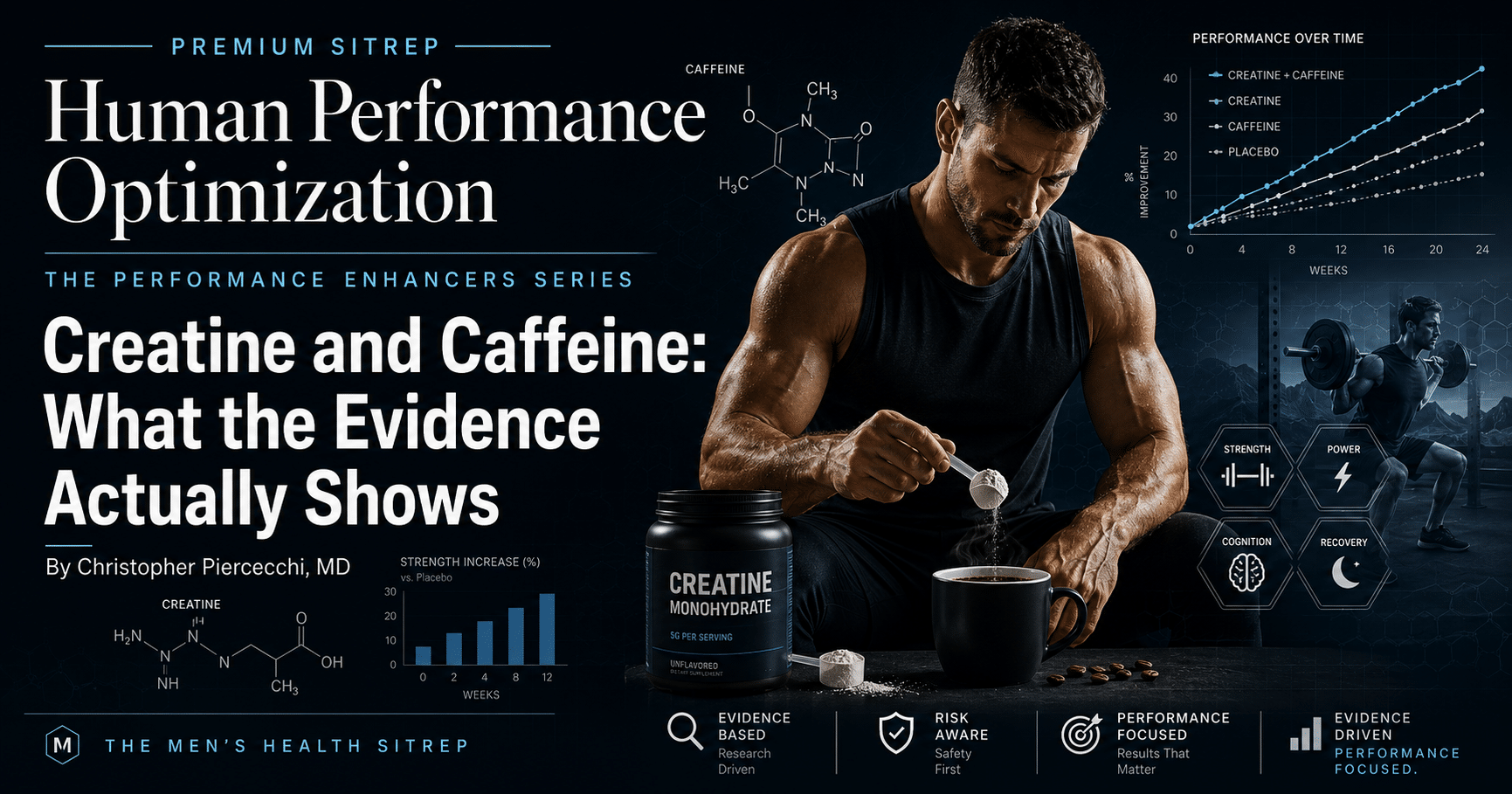
Creatine and Caffeine: What the Evidence Actually Shows
By Christopher Piercecchi, MD
This article is for educational purposes only and is not personal medical advice. It does not create a physician-patient relationship. Decisions about your health should be made with a qualified clinician who knows your history.
Gentlemen, in the first SITREP in this Human Performance Series, published last week, I laid out the basic problem. Men are constantly bombarded with claims about how to enhance their physical performance: how to become stronger and faster, improve their endurance, and recover more effectively. The truth is that most of these claims are nonsense. By nonsense, I mean that many have little or no basis in established fact. Others may show some promise, but they are not yet supported by high-quality evidence. At best, they remain hypotheses, ideas about what a product or compound might be capable of doing. As any scientist knows, a hypothesis may be worth investigating, but until it has been properly tested and supported by convincing evidence, it cannot be presented as proven.
The products and compounds being marketed to men cover a wide range. Some are simply forms of basic nutrition. Others claim to optimize nutrition in some particular way. A small number are legitimate ergogenic aids, meaning they have been shown to improve some aspect of exercise capacity, recovery, or physical performance. Many, however, are simply overmarketed supplements. More recently, we have also begun to see prescription hormones, peptides, and experimental compounds aggressively promoted as performance enhancers, often without sound evidence that they are effective, safe, or appropriate for the men being encouraged to use them.
Today we will begin a deeper review of the various performance enhancers being marketed to men. The goal is simple: to determine which of them actually work and which are nonsense.
Back to All Blogs