
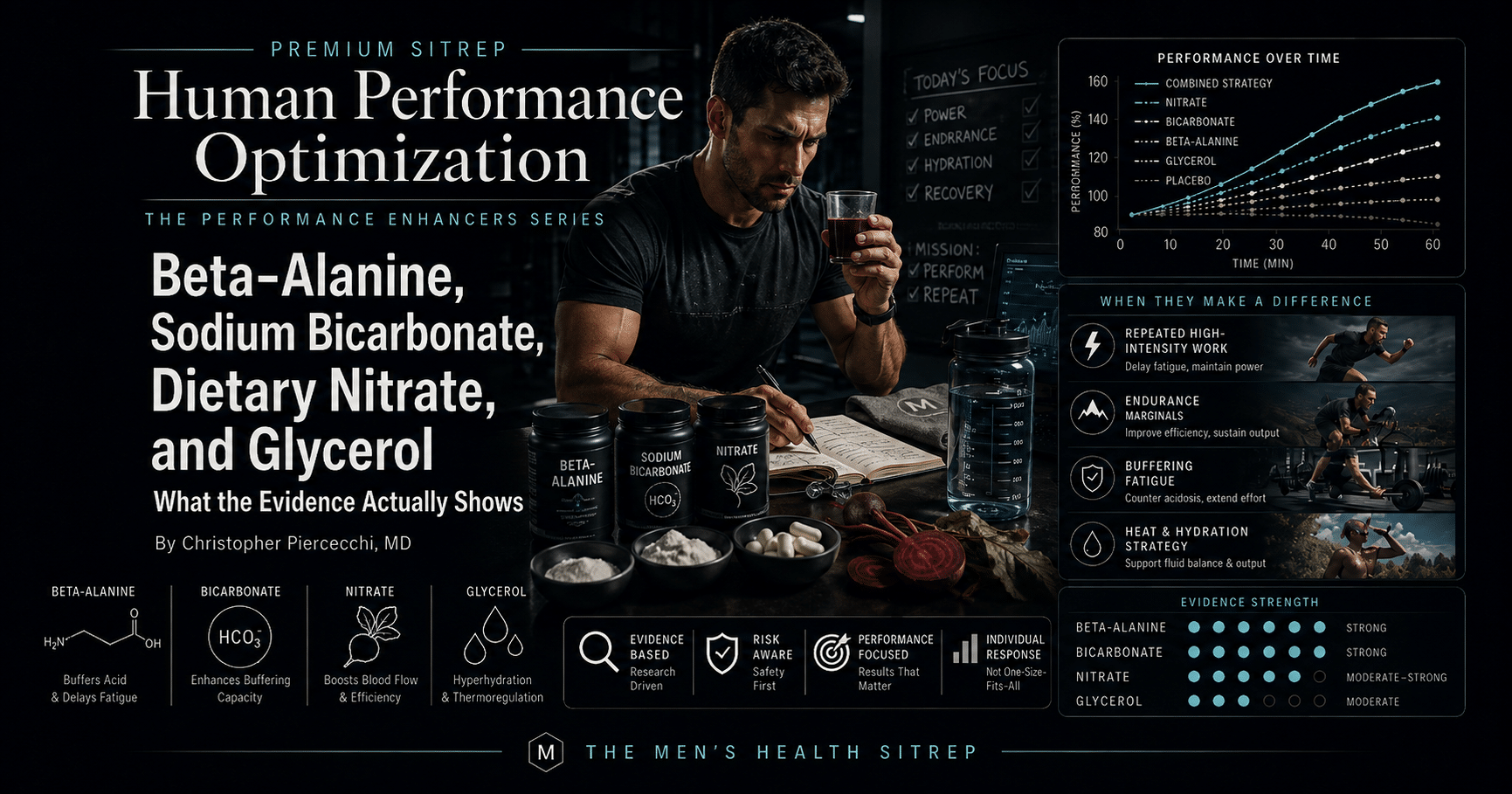
Beta-Alanine, Sodium Bicarbonate, Dietary Nitrate, and Glycerol: What the Evidence Actually Shows
By Christopher Piercecchi, MD
Physician and Wellness Manager, Founder, The Men’s Clinic for Wellness & Vitality
This article is for educational purposes only and is not personal medical advice. It does not create a physician-patient relationship. Decisions about supplements, exercise, and medical conditions should be made with a qualified clinician who knows your history.
Gentlemen, before we move further into the performance-supplement world, it is worth briefly reviewing what we have established so far because the hierarchy matters.
We began with creatine and caffeine, two of the few legal performance supplements with enough human evidence to deserve serious consideration. Creatine is primarily useful for strength, power, and repeated high-intensity exercise. By increasing the amount of phosphocreatine available in muscle, it can help someone produce slightly more work during hard efforts, recover more effectively between repeated efforts, and accumulate somewhat more productive training over time. When combined with resistance training, that can contribute to small additional gains in strength and lean mass.
Creatine does not build muscle or create strength by itself. The exercise still provides the stimulus, and the supplement may allow the athlete to get slightly more from that training. Its clearest applications are in power athletes, strength athletes, resistance training, sprinting, and sports requiring repeated bursts of intense effort. Current evidence does not show a consistent direct improvement in conventional endurance performance among trained endurance athletes, although it may still have a limited role when an endurance event includes repeated surges, sprints, or strength training as part of the athlete’s larger program. The additional water and body mass that sometimes accompany creatine may also be undesirable in weight-bearing endurance events.[1,2]
Caffeine works differently. It can improve alertness, reduce perceived effort, and delay fatigue, and it may provide a small advantage in endurance exercise, repeated high-intensity work, and some strength or power activities. It is an acute performance aid, meaning the effect occurs after taking it rather than after weeks of loading. That makes caffeine broadly useful, but it also makes it easy to misuse.
More caffeine does not produce proportionally more performance. Higher doses increase the likelihood of anxiety, shakiness, gastrointestinal distress, a racing or forceful heartbeat, elevated blood pressure, and impaired coordination or concentration. It can also interfere with sleep, which may do more damage to recovery and subsequent performance than the caffeine contributed to the workout. Individual responses vary considerably, and people with certain cardiovascular conditions, anxiety disorders, sleep problems, medication interactions, or unusual caffeine sensitivity need to be particularly cautious. Very high doses produce more adverse effects without reliably producing greater exercise benefits.[3]
After creatine and caffeine, we moved to the part of performance optimization that receives much less attention because it does not come in an exciting bottle: fueling.
Fueling is the foundation. A man cannot repeatedly train hard, recover properly, and adapt to that work if he is chronically underfed, short on protein, depleted of carbohydrate, dehydrated, or failing to replace substantial sodium losses. For someone performing long endurance sessions, repeated high-intensity training, high-volume resistance exercise, or demanding work in heat, appropriate carbohydrate, fluid, sodium, and protein intake will usually matter far more than any supplement discussed in this series.
That does not mean everyone needs a special pre-workout meal, sports drink, recovery shake, or carbohydrate-loading plan. A man who goes to the gym for thirty minutes, walks on a treadmill, and performs a few moderate sets can generally support that activity by eating ordinary meals and drinking normally. Eating a large carbohydrate meal before that session and then consuming another large “recovery” meal afterward does not optimize the workout. It may simply add calories that the exercise did not require.
Specialized fueling becomes important when the work is hard enough, long enough, frequent enough, or hot enough to create a genuine fuel or fluid problem. Carbohydrate intake during exercise becomes increasingly relevant as strenuous activity exceeds about an hour, particularly during prolonged endurance work. Aggressive carbohydrate replacement after exercise matters most when glycogen has been depleted, and another demanding session is approaching. For an ordinary recreational workout, normal daily nutrition is usually sufficient.[4]
That brings us to the next group.
Ergogenic Aids
Beta-alanine, sodium bicarbonate, dietary nitrate, and glycerol are commonly described as ergogenic aids. Ergogenic simply means capable of improving physical work or performance. These substances are heavily marketed, frequently included in pre-workout formulas, and associated with claims about greater endurance, more power, improved blood flow, better hydration, delayed fatigue, and faster recovery.
Some of those claims began with legitimate research. Each of these substances has a real physiological effect, and each may improve certain performance measures under the right conditions. That does not mean they improve all forms of exercise, and it certainly does not mean that everyone taking them is likely to benefit.
The central question is no longer simply whether a supplement works. We need to ask what type of exercise it improves, how large the improvement is, what dose produced it, what disadvantages accompany it, and whether the person buying it is performing the kind of work in which the effect could possibly matter.
That is where the research and the marketing frequently part ways.
Back to All Blogs