
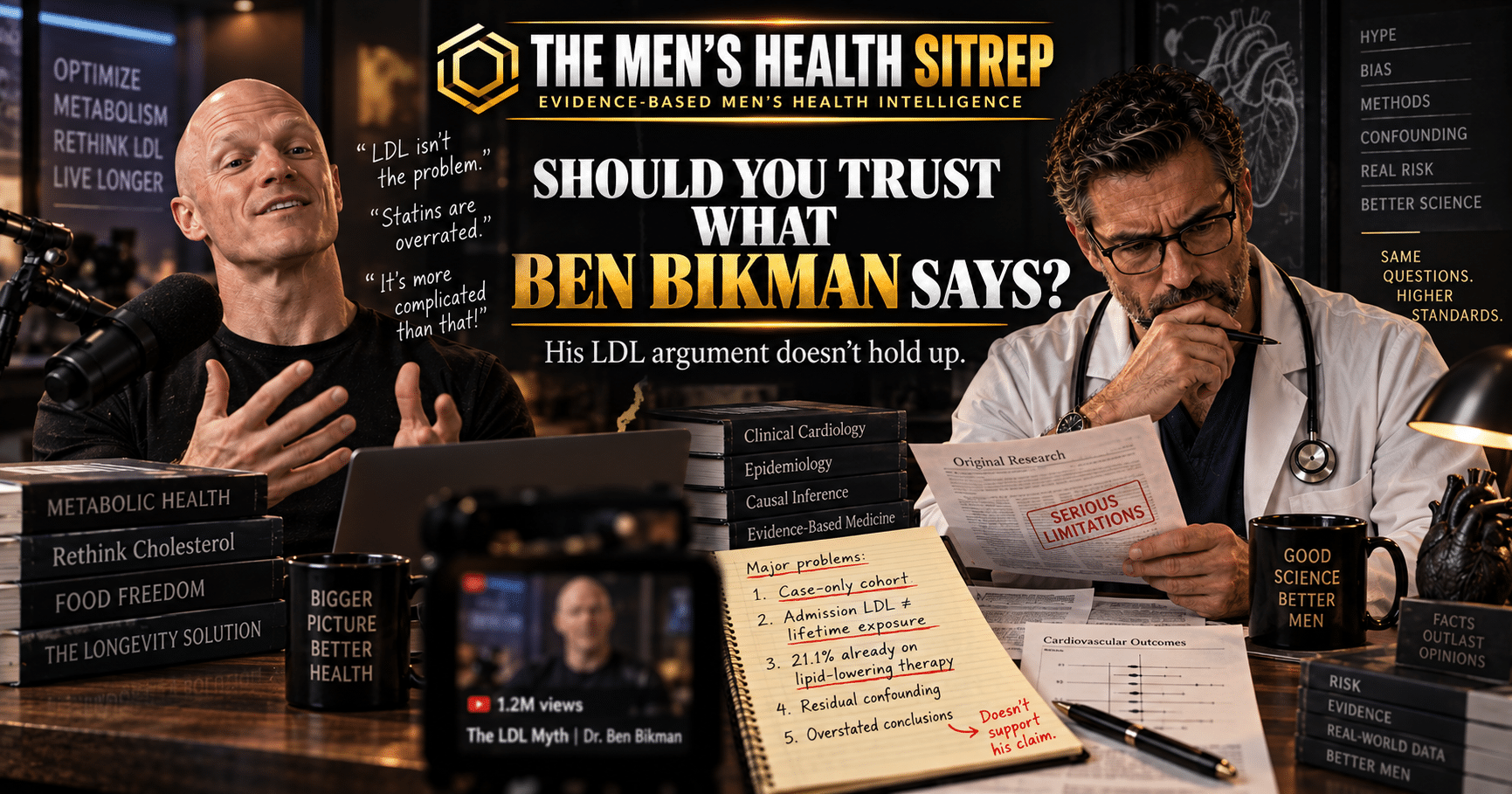
By Christopher Piercecchi, MD — Physician and Wellness Manager, Founder, The Men’s Clinic for Wellness & Vitality
SITREP is an evidence-review briefing for patients and colleagues of The Men’s Clinic for Wellness & Vitality. It is educational and does not constitute individualized medical advice. This piece critiques specific public scientific claims and the evidence supporting them.
Benjamin Bikman, PhD, has become a well-known voice in the world of metabolic health. And for good reason. He’s a legitimate scientist who has spent much of his career studying insulin resistance and how the body uses energy. He’s published extensively, holds an academic position, and has built a large following through podcasts, interviews, and YouTube. He clearly knows his field. But some of his recent arguments about LDL cholesterol and cardiovascular disease raise questions about how he’s interpreting the science.
One thing I’ve noticed with scientists who become popular health personalities is that their expertise can start to carry more weight than it should. Someone may know an extraordinary amount about one area of human biology, but that doesn’t necessarily make them an expert in every other area of medicine. Bikman isn’t a physician, something he openly acknowledges, and there’s nothing wrong with that. His background is in metabolic research. But understanding how insulin works is not the same as understanding everything we know about what causes heart disease, how to assess someone’s risk, or which treatments actually prevent heart attacks.
And I think this is where things can get confusing for the public. When someone has a PhD, teaches at a university, and can explain complicated biology in a way that makes sense, it’s natural to assume their conclusions are well supported. Sometimes they are. But an explanation that sounds convincing isn’t necessarily the same thing as one that’s supported by the evidence. That’s especially true in medicine, where we have to look beyond how we think something works and ask what actually happens to people over time. That’s where I have a problem with Bikman’s arguments about LDL. It’s not that he isn’t qualified to have an opinion, or even that he disagrees with the conventional view. It’s that I don’t think the evidence he uses supports the conclusions he’s asking people to accept.
The Claim
In a May 29, 2025 interview on the Good Life Project, Bikman is asked about cholesterol. He begins with a reasonable disclaimer: “My view is that of a biomedical scientist and not a clinician.” But what follows is a pretty bold statement. He calls LDL cholesterol “one of the worst markers ever relied on for heart disease.” [1]
Back to All Blogs