
By Christopher Piercecchi, MD
Physician and Wellness Manager, Founder, The Men’s Clinic for Wellness & Vitality
SITREP is an evidence-review briefing for patients and colleagues of The Men’s Clinic for Wellness & Vitality. It is educational and does not constitute individualized medical advice.
BOTTOM LINE UP FRONT
American medicine has become exceptionally good at diagnosing and treating established disease. What it has not done nearly as well is develop a system specifically designed to prevent that disease from developing in the first place. The problem is not necessarily the competence of our primary-care physicians. It is the structure of primary care itself.
Today’s primary-care physician is expected to manage acute illnesses, chronic diseases, medications, screening recommendations, and preventive counseling, often within appointments lasting less than 20 minutes. One published analysis estimated that a physician with a typical panel of 2,500 adults would require 26.7 hours per day to fulfill all guideline-recommended responsibilities. Under these conditions, meaningful prevention often becomes little more than an annual physical, routine laboratory testing, age-based screening, and generalized lifestyle advice.
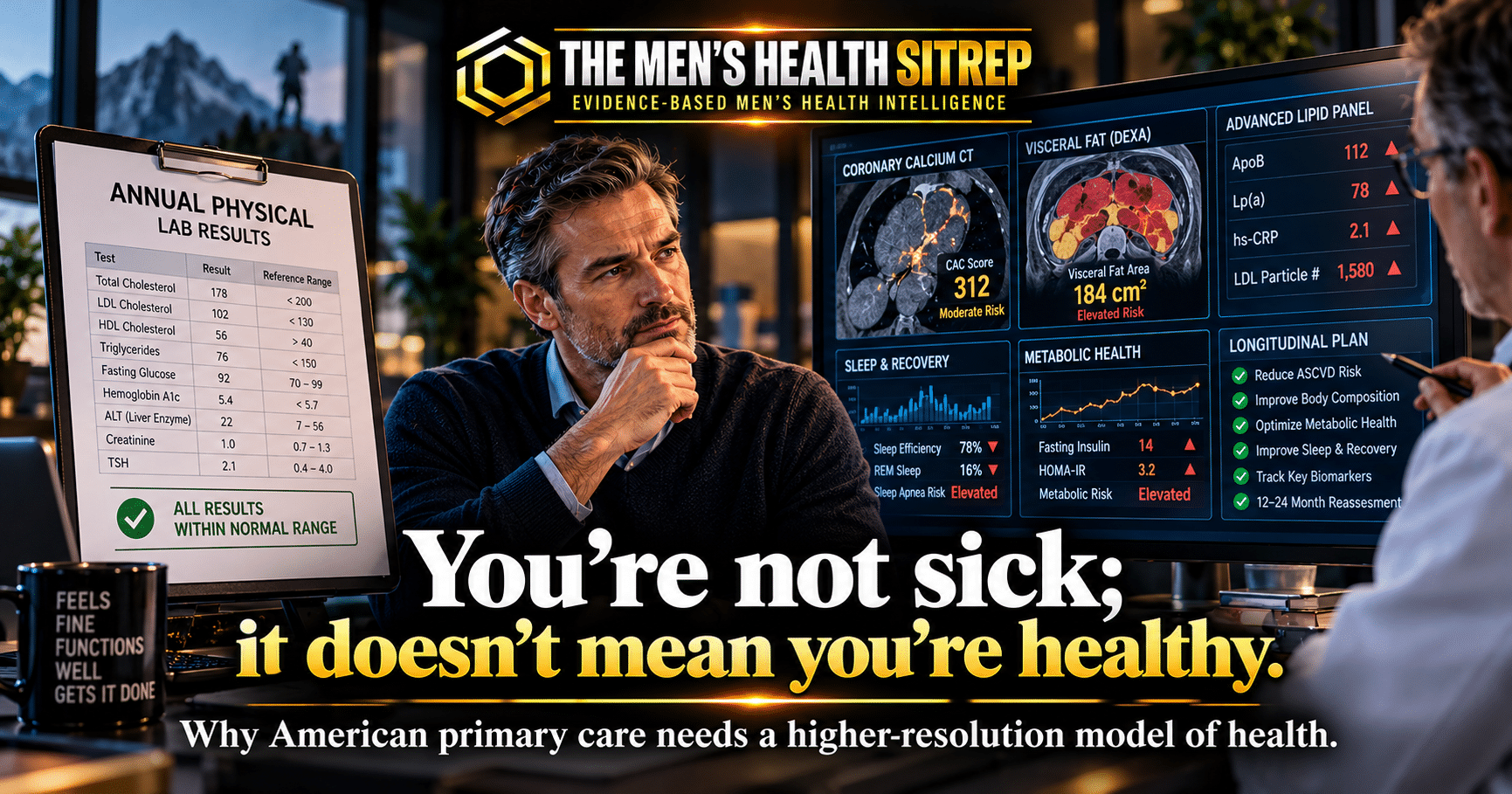
But an annual physical is not the same thing as preventive medicine. Normal laboratory results do not necessarily mean someone is healthy or at low risk for future disease. Conventional testing may overlook important cardiovascular, metabolic, functional, and behavioral risks. More sophisticated assessments, including ApoB, lipoprotein(a), coronary calcium scoring, physiologic testing, and body-composition measurements, can provide additional clinically useful information in appropriately selected patients. The objective, however, is not simply to order more tests. It is to obtain information that meaningfully changes clinical decisions and improves patient management.
There is also a fundamental difference between providing lifestyle advice and actually managing someone’s wellness. Telling a patient to exercise more, eat better, lose weight, or improve sleep is not the same as developing an individualized treatment plan, implementing it, measuring the results, and making adjustments when necessary. Exercise, nutrition, sleep, body composition, and other modifiable health risks deserve the same clinical attention, objective monitoring, and accountability that we routinely apply to medications and established diseases.
What I’m proposing
I believe preventive medicine should become a more clearly defined, physician-led clinical discipline, something I call Preventive Care and Wellness Management.
This approach would begin with an individualized assessment of the factors most likely to cause serious disease, disability, or premature death. It would use appropriately selected diagnostic testing to characterize those risks, followed by a personalized management plan integrating evidence-based medications, exercise, nutrition, sleep treatment, and other interventions. Implementation would involve collaboration with exercise physiologists, dietitians, physical therapists, sleep specialists, and other professionals when appropriate. Most importantly, interventions would be objectively monitored, reassessed, and adjusted over time.
This model would not necessarily replace traditional primary care. It could be incorporated into a redesigned primary-care system or function as a separate discipline working alongside a patient’s primary-care physician.
What we still need to establish
Individual preventive interventions have varying levels of scientific evidence supporting their effectiveness. However, we do not yet have adequate clinical evidence demonstrating that combining these interventions into a dedicated, intensive preventive-care model produces better long-term outcomes than conventional primary care alone. That is an important distinction.
The model deserves rigorous prospective evaluation, ultimately including randomized trials examining cardiovascular events, metabolic disease progression, disability, mortality, cost, and potential harms from unnecessary testing or treatment.
The bottom line
We need to move preventive medicine beyond episodic screening and generalized counseling toward a dedicated, physician-directed system focused on objectively managing an individual’s long-term health trajectory.
The central question should no longer be limited to what is wrong with you today? We should also be asking:
What is most likely to cause you serious disease, disability, or premature death? Can we identify evidence of those risks today? What can we do to change them? And how will we know whether our interventions are actually working?
That is the central argument of this SITREP. Prevention should not simply be something we discuss during medical appointments. It should be something we actively practice, measure, and manage over time.
The White Paper
Executive Summary
American medicine has developed extraordinary capacity to diagnose and treat established disease. It has cardiologists for coronary disease, electrophysiologists for arrhythmias, nephrologists for kidney failure, endocrinologists for diabetes, oncologists for cancer, and surgeons for advanced structural disease. Yet the clinical infrastructure charged with preventing those diseases remains comparatively diffuse, under-resourced, and constrained by a model of care that frequently reduces prevention to an annual examination, several laboratory tests, age-based screening recommendations, and brief counseling about diet, exercise, or weight.
This is not principally a failure of individual physicians. It is a failure of design. The National Academies defines high-quality primary care as whole-person, integrated care that addresses an individual’s health and wellness needs across settings and over sustained relationships, while acknowledging that this description remains aspirational and does not reflect what many Americans actually receive.[1] Only 8% of U.S. adults age 35 and older were found in one national analysis to have received all of the high-priority clinical preventive services for which they were eligible.[2] A subsequent simulation estimated that a primary-care physician responsible for a typical panel of 2,500 adults would require 26.7 hours per day to provide guideline-recommended preventive, chronic, acute, documentation, and inbox care, including 14.1 hours per day for preventive care alone.[3] The problem is therefore not simply that primary-care physicians should perform prevention more diligently. The job, as presently constructed, often makes comprehensive prevention mathematically impossible.
The consequence is what might be described as an extraordinarily low-resolution assessment of health. A patient can attend medical appointments for years, receive a conventional lipid panel, glucose or hemoglobin A1c measurement, a blood-pressure reading, routine cancer-screening reminders, and generic lifestyle counseling, yet still leave without a detailed understanding of his long-term cardiovascular, metabolic, functional, or behavioral trajectory. Having a primary-care physician and receiving sophisticated preventive medicine are not necessarily the same thing.
This paper proposes that prevention should be recognized as a more distinct clinical function, here termed Preventive Care and Wellness Management. Its purpose would not be to replace acute or chronic-disease medicine, nor to indiscriminately screen asymptomatic people for every conceivable abnormality. Its purpose would be to identify an individual’s most important modifiable health risks, characterize those risks with sufficient resolution to guide management, intervene before clinical disease becomes advanced, and repeatedly measure whether those interventions are working.
The central unit of conventional primary care is often the encounter. The central unit of preventive wellness management should be the patient’s health trajectory.
Primary Care’s Preventive Mission and the Reality of the Modern Visit
Primary care is theoretically the natural home of prevention. The National Academies describes it as accountable for addressing the majority of an individual’s health and wellness needs across time.[1] Greater availability of primary-care physicians has also been associated with better population outcomes. In a large U.S. county-level analysis from 2005 through 2015, every additional 10 primary-care physicians per 100,000 population was associated with approximately 51.5 additional days of life expectancy and lower cardiovascular, cancer, and respiratory mortality. These observational findings do not establish causation, but they argue strongly against portraying primary care itself as unnecessary.[4]
The problem is that the mission assigned to primary care is considerably larger than the resources provided to accomplish it. The average primary-care examination in an analysis of more than 21 million visits was approximately 18 minutes.[5] Within that period, clinicians may need to address acute complaints, chronic diseases, prescriptions, medication reconciliation, mental health, screening recommendations, immunization, documentation, laboratory abnormalities, patient questions, insurance requirements, and preventive counseling. The previously noted workload analysis calculated that guideline-concordant care for a typical panel would require more than an entire day’s labor for preventive care alone.[3] Even with substantial delegation to a team, estimated total daily care requirements remained 9.3 hours.
The financing structure reinforces this compression. The 2025 U.S. Primary Care Scorecard reported that less than 5% of total U.S. health spending went to primary care in 2022 and argued that fee-for-service reimbursement continues to reward procedural activity more generously than longitudinal comprehensive care.[6] Whatever one thinks about the precise policy remedies, the mismatch is difficult to ignore: primary care is expected to prevent disease, manage chronic illness, respond to acute problems, coordinate specialists, maintain access, perform documentation, and satisfy increasingly complex quality requirements while receiving only a small fraction of overall health-care resources.
The predictable result is a model optimized for throughput and encounters rather than detailed longitudinal health management. That does not mean a physician sees a patient for 18 minutes and provides 18 minutes of thought. Nor does it mean that every brief visit is poor care. It means that a system built around short encounters creates structural pressure toward triage, prioritization, and minimum sufficient action. When the immediate problem is a respiratory infection, medication refill, knee complaint, or uncontrolled diabetes, the less urgent work of determining how a currently functional 45-year-old can remain healthy at 65 is easy to postpone.
The Annual Physical Is Not the Same as Preventive Medicine
A tempting response is simply to call for larger annual physicals and more testing. The evidence does not support that conclusion.
A 2019 Cochrane review evaluated 17 randomized trials of general health checks involving more than 250,000 participants. General health checks produced little or no reduction in all-cause mortality, cancer mortality, or cardiovascular mortality.[7] They identified additional abnormalities and increased diagnostic activity, but simply screening broadly for multiple diseases did not translate into demonstrated mortality benefit.
This finding is critical. The alternative to inadequate preventive care cannot simply be indiscriminate testing.
Higher-resolution prevention should instead mean better clinical discrimination. The physician must understand which measurements provide actionable information for a particular patient, which results would alter treatment, how frequently reassessment is justified, and where testing is more likely to generate false positives, incidental findings, unnecessary procedures, cost, anxiety, or overtreatment.
Preventive expertise therefore consists as much of knowing what not to test as knowing what to investigate.
The distinction also exposes an important limitation in the traditional annual physical. A normal collection of common laboratory measurements does not establish that a patient has a low probability of future disease. A patient may have acceptable fasting glucose while accumulating visceral adiposity. An apparently acceptable LDL cholesterol concentration may coexist with elevated lipoprotein(a), discordant apolipoprotein B, or substantial subclinical coronary atherosclerosis. A single acceptable office blood-pressure measurement does not necessarily characterize habitual blood pressure, which is why the U.S. Preventive Services Task Force recommends out-of-office measurement when confirming hypertension.[8] Prevention requires longitudinal information, not merely a snapshot.
Cardiovascular Prevention Demonstrates the Resolution Problem
Cardiovascular prevention offers perhaps the clearest example of how the concept of risk assessment is evolving beyond a basic annual laboratory panel.
Modern cardiovascular risk assessment remains grounded in population evidence. That foundation should not be discarded. Multivariable risk equations such as PREVENT integrate established risk factors to estimate future cardiovascular risk, and such tools are enormously useful for translating population evidence to clinical decision-making.[9] The mistake is treating a population-derived estimate as though it completely characterizes the individual sitting in the examination room.
Contemporary lipid guidance increasingly acknowledges this limitation. The 2026 ACC/AHA multisociety dyslipidemia guideline recommends measuring lipoprotein(a) at least once in adulthood, recognizes a role for apolipoprotein B when the conventional lipid profile may underestimate residual atherogenic risk, and states that coronary artery calcium assessment can improve risk stratification in appropriate adults, including men beginning at age 40 and women beginning at age 45.[10]
Coronary calcium illustrates why additional resolution can matter. In the Multi-Ethnic Study of Atherosclerosis, 10-year ASCVD event rates among participants with CAC of zero ranged from approximately 1.3% to 5.6%, whereas rates among those with CAC greater than 300 ranged from 13.1% to 25.6%, despite conventional demographic and clinical risk assessment.[11] CAC therefore reveals information about actual accumulated coronary atherosclerotic burden that cannot always be inferred from a conventional lipid panel or short-term risk estimate alone.
But this example also demonstrates why evidence discipline is essential. The fact that CAC predicts events extraordinarily well does not mean every adult should automatically undergo CAC imaging. Randomized evidence has not established that universal CAC screening reduces myocardial infarction or mortality. The EISNER randomized trial showed that CAC imaging followed by counseling was associated with favorable changes in several cardiovascular risk factors, including systolic pressure and LDL cholesterol, but it was not a definitive outcomes trial.[12] The appropriate lesson is therefore not “scan everyone.” It is that a preventive physician should understand when direct characterization of subclinical disease meaningfully changes management and when it does not.
The same principle applies to blood pressure, obesity, metabolic health, sleep, exercise capacity, bone health, cancer prevention, and other domains. The objective is not maximal data acquisition. It is maximal acquisition of useful clinical information.
From Prevention to Wellness Management
The more fundamental deficiency in conventional preventive care may occur after risk has been identified.
Telling a patient to “exercise more,” “eat better,” or “lose weight” is not equivalent to managing exercise, nutrition, or obesity. Older national studies of U.S. primary-care practice illustrate how large this implementation gap can be. In one nationally representative physician survey, fewer than half of primary-care physicians reported consistently providing specific diet, physical-activity, or weight-control guidance, and fewer than 22% reported consistently tracking patients over time regarding weight or weight-related behavior.[13] These data are older and should not be assumed to describe every contemporary practice, but they illustrate a persistent conceptual problem: lifestyle advice is often treated as counseling rather than as a medical intervention requiring prescription, monitoring, adjustment, and accountability.
Consider exercise. If exercise is being used therapeutically to improve blood pressure, insulin sensitivity, cardiorespiratory fitness, muscle mass, physical function, and long-term cardiovascular risk, then “try to exercise three times a week” is an unusually imprecise prescription. A higher-resolution model would establish the patient’s baseline activity and functional capacity, identify relevant medical limitations, define an appropriate aerobic and resistance-training dose, arrange expert implementation where appropriate, measure adherence, and reassess objective outcomes. The physician need not personally supervise every workout. The physician’s role is to integrate exercise into the medical strategy, determine its safety and clinical purpose, and ensure that it is actually being implemented.
Nutrition should be approached similarly. A preventive clinician does not need to become the patient’s personal chef or replace a skilled registered dietitian. The physician does need enough nutritional knowledge to recognize relevant dietary patterns, energy imbalance, inadequate protein intake where clinically relevant, excessive alcohol intake, disordered eating, or nutritional strategies incompatible with the patient’s metabolic goals, and then coordinate appropriate treatment.
The same principle applies to obesity management. If central adiposity, metabolic dysfunction, or obesity meaningfully contributes to long-term risk, treatment should not end with generic advice. It may require structured nutritional intervention, activity modification, behavioral treatment, pharmacotherapy when appropriate, objective measurement, and continued follow-up.
That is the distinction between preventive advice and wellness management.
Wellness management treats modifiable health risks in the way medicine treats other clinically important variables: establish a baseline, intervene, measure the response, adjust the intervention, and continue surveillance.
A Proposed Model: Preventive Care and Wellness Management
A dedicated preventive-care physician would not primarily exist to treat sore throats or manage the routine logistics of every stable chronic illness. The physician’s principal responsibility would be to understand and influence the patient’s health trajectory before advanced disease appears.
The initial evaluation would begin with conventional medical history and examination but would extend deliberately into longitudinal risk. Family history, blood-pressure exposure, tobacco and alcohol use, weight history, central adiposity, metabolic health, sleep, physical activity, cardiorespiratory and muscular fitness, relevant reproductive and hormonal issues, medication exposure, cancer risk, and cardiovascular risk would be assessed in sufficient depth to identify the dominant threats to future health.
Testing would then be individualized rather than protocolized indiscriminately. Standard laboratory measurements would remain important, but additional biomarkers, physiologic testing, imaging, or specialist evaluation would be obtained only when the clinician could articulate why the information matters and how a particular result might alter management.
The central product of the encounter would not be a collection of laboratory values. It would be a longitudinal health-management plan.
That plan might include pharmacologic treatment of hypertension, dyslipidemia, obesity, diabetes risk, osteoporosis, smoking dependence, or other appropriate conditions. It might include a defined exercise strategy, nutritional targets, sleep treatment, alcohol reduction, specialist referral, or surveillance. Equally important, each intervention would have a predefined method and interval for determining whether it worked.
This function should remain physician-led because it requires differential diagnosis, assessment of competing medical risks, interpretation of diagnostic studies, prescription medications, management of adverse effects, recognition of disease requiring referral, and judgment regarding the probability that a proposed intervention will provide more benefit than harm. But physician-led should not mean physician-only. Exercise physiologists, physical therapists, dietitians, psychologists, sleep professionals, pharmacists, and other clinicians may deliver major components of the plan. The physician’s role is integration and medical judgment.
Must Preventive Care Replace Primary Care?
Not necessarily.
One possible model would integrate this function into redesigned primary care. A sufficiently resourced primary-care physician with a smaller panel, longer appointments, an effective interdisciplinary team, appropriate diagnostic capabilities, and reimbursement for longitudinal management could theoretically provide both traditional primary care and high-resolution prevention.
A second model would separate the functions. Traditional primary care could remain principally responsible for acute illness, established chronic disease, routine coordination, and general medical needs, while a preventive-care physician assumes longitudinal responsibility for risk characterization and wellness management. A patient might therefore have both a general primary-care physician and a preventive physician in much the same way that patients with complicated cardiovascular risk sometimes simultaneously have a general physician and preventive cardiologist.
The latter approach creates an obvious danger: fragmentation. Two physicians can duplicate testing, prescribe conflicting therapies, misunderstand responsibility, and generate additional cost. Any separate preventive discipline would therefore require explicit communication, shared records, clear domains of responsibility, and an obligation to reduce rather than multiply unnecessary medical activity.
The evidence presently does not tell us which structure is superior. That is precisely why the proposal should initially be framed as a clinical model requiring prospective evaluation rather than a predetermined restructuring of American medicine.
There is also already an established specialty of Public Health and General Preventive Medicine. Its ACGME-defined mission includes the promotion and maintenance of health and prevention of disease and premature death, but its training also has an important population-health, public-health, and epidemiologic orientation.[14] The model proposed here is narrower and more clinically intensive: individualized longitudinal prevention for adults who may currently feel well but possess modifiable risk for future disease.
What This Proposal Does Not Claim
A credible preventive-care model must resist several seductive but unsupported assumptions.
First, more testing is not necessarily better medicine. Screening can produce false positives, incidental findings, radiation exposure, invasive follow-up, anxiety, expense, and treatment of abnormalities that would never have caused harm. The failure of broad general health checks to reduce mortality is an important warning against equating comprehensiveness with the number of tests ordered.[7]
Second, this proposal does not establish that internists or family physicians are incompetent. Primary care physicians operate within the very system being criticized, and greater access to primary care is associated with better population outcomes.[4] The evidence supports criticism of an inadequately resourced and excessively compressed model much more strongly than a blanket indictment of one specialty.
Third, it cannot yet be claimed that a high-intensity preventive model such as the one described here reduces mortality compared with contemporary primary care. That comparison largely has not been performed. Biomarkers, imaging, fitness measurements, body composition, structured nutrition, pharmacologic risk reduction, and sleep treatment each possess different levels of evidentiary support. Combining them into a coherent clinical model is biologically and clinically plausible, but the overall model still requires outcomes research.
These limitations do not weaken the proposal. They define its scientific obligations.
The Research Question Medicine Should Now Ask
The central research question should no longer be whether patients benefit from having access to primary care. The evidence strongly suggests that they do.
The more interesting question is whether a higher-resolution, physician-led preventive-care model with longitudinal wellness management produces better risk-factor control, better functional health, earlier appropriate identification of important disease, better patient engagement, and ultimately fewer major clinical events than conventional primary care alone, without producing unacceptable overdiagnosis, overtreatment, or cost.
That question can be tested.
Initial studies could compare matched populations receiving conventional care with patients receiving conventional care plus structured preventive wellness management. Outcomes could include blood-pressure control, ApoB and LDL exposure where appropriate, body weight and waist trajectory, smoking cessation, glycemic measures, physical fitness, appropriate sleep-apnea treatment, adherence to proven cancer screening, medication adherence, hospitalization, downstream diagnostic testing, patient-reported health, total health-care utilization, and adverse consequences of screening.
Ultimately, pragmatic randomized trials should determine whether such a model reduces cardiovascular events, progression of metabolic disease, disability, and premature mortality.
If it does not, the model should not be defended merely because it feels more thorough.
If it does, prevention deserves a substantially larger role in the organization of adult medicine.
Conclusion
American primary care has been asked to be nearly everything at once: first-contact medicine, chronic-disease management, preventive care, mental-health triage, medication management, care coordination, administrative interface, and longitudinal physician relationship. It has been given limited time and a relatively small proportion of health-care resources with which to perform those functions. The result should not be surprising.
What has become normalized is an unusually low-resolution assessment of health.
A patient can repeatedly interact with the health-care system without anyone assuming explicit responsibility for the long-term trajectory of that patient’s health. Risk factors may be documented without being aggressively managed. Lifestyle may be discussed without being prescribed. Interventions may be recommended without being monitored. Conventional laboratory measurements may be reviewed without asking whether they adequately characterize the biological processes most likely to cause future disease.
Preventive medicine should aspire to something more demanding.
Its central questions should be simple: What is most likely to cause this individual serious disease, disability, or premature death? What evidence of that process already exists? Which of those risks can meaningfully be changed? What intervention has the best evidence and acceptable tradeoffs? And when we reassess the patient, did it work?
That is not an argument for practicing more medicine merely because more medicine is available. It is an argument for practicing preventive medicine with greater resolution, greater accountability, and greater clinical judgment.
The conventional medical encounter asks what is wrong with the patient today.
A mature system of preventive care must also ask where the patient is going.
And somebody in medicine should be explicitly responsible for changing that trajectory.
References
-
National Academies of Sciences, Engineering, and Medicine. Implementing High-Quality Primary Care: Rebuilding the Foundation of Health Care. Washington, DC: National Academies Press; 2021. doi:10.17226/25983.
-
Borsky A, Zhan C, Miller T, Ngo-Metzger Q, Bierman AS, Meyers D. Few Americans receive all high-priority, appropriate clinical preventive services. Health Aff (Millwood). 2018;37(6):925-928. doi:10.1377/hlthaff.2017.1248.
-
Porter J, Boyd C, Skandari MR, Laiteerapong N. Revisiting the time needed to provide adult primary care. J Gen Intern Med. 2023;38:147-155. PMID: 35776372.
-
Basu S, Berkowitz SA, Phillips RL, Bitton A, Landon BE, Phillips RS. Association of primary care physician supply with population mortality in the United States, 2005-2015. JAMA Intern Med. 2019;179(4):506-514. doi:10.1001/jamainternmed.2018.7624.
-
Tai-Seale M, et al. Measuring primary care exam length using electronic health record data. Med Care. 2021. PMID: 33301282.
-
Jabbarpour Y, Jetty A, Byun H, Siddiqi A, Park J. The Health of US Primary Care: 2025 Scorecard Report: The Cost of Neglect. Milbank Memorial Fund; 2025.
-
Krogsbøll LT, Jørgensen KJ, Gøtzsche PC. General health checks in adults for reducing morbidity and mortality from disease. Cochrane Database Syst Rev. 2019;1. doi:10.1002/14651858.CD009009.pub3.
-
U.S. Preventive Services Task Force. Screening for hypertension in adults. 2021.
-
Khan SS, Matsushita K, Sang Y, et al. Development and validation of the American Heart Association’s PREVENT equations. Circulation. 2024;149(6):430-449. doi:10.1161/CIRCULATIONAHA.123.067626.
-
American College of Cardiology/American Heart Association Joint Committee on Clinical Practice Guidelines. 2026 ACC/AHA multisociety guideline on the management of dyslipidemia. Circulation. 2026. doi:10.1161/CIR.0000000000001423.
-
Budoff MJ, Young R, Burke G, et al. Ten-year association of coronary artery calcium with atherosclerotic cardiovascular disease events: the Multi-Ethnic Study of Atherosclerosis. Eur Heart J. 2018;39(25):2401-2408. PMID: 29688297.
-
Rozanski A, Gransar H, Shaw LJ, et al. Impact of coronary artery calcium scanning on coronary risk factors and downstream testing: the EISNER prospective randomized trial. J Am Coll Cardiol. 2011;57(15):1622-1632. doi:10.1016/j.jacc.2011.01.019.
-
Smith AW, Borowski LA, Liu B, et al. U.S. primary care physicians’ diet-, physical activity-, and weight-related care of adult patients. Am J Prev Med. 2011;41(1):33-42. PMID: 21665061.
-
Accreditation Council for Graduate Medical Education. Program Requirements for Graduate Medical Education in Public Health and General Preventive Medicine. Effective July 1, 2026.